* These statements have not been evaluated by the Food and Drug Administration. This product is not intended to diagnose, treat, cure, or prevent any disease. For research purposes only.
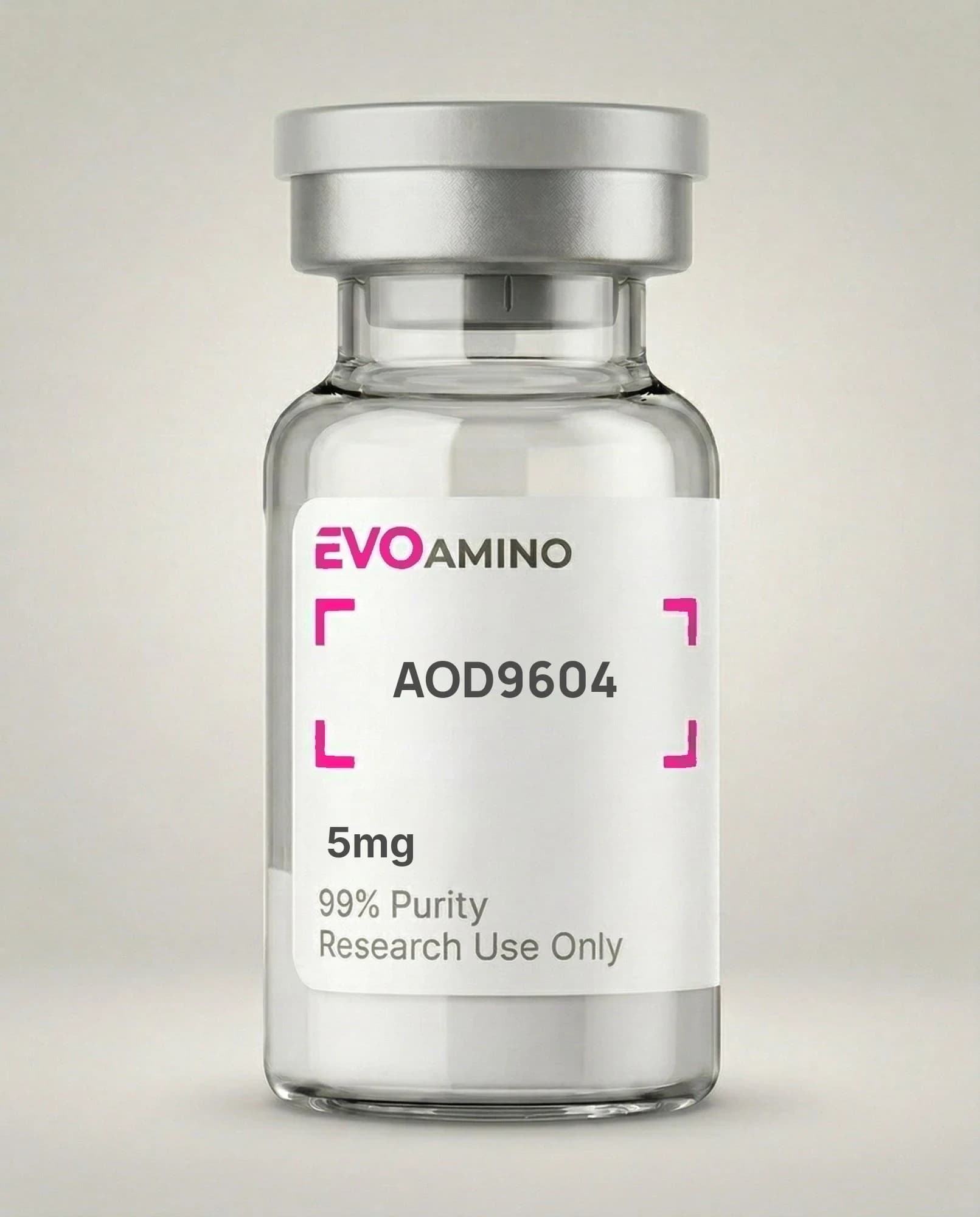
AOD9604 is a synthetic peptide studied in research for its relationship to human growth hormone (hGH). It is catalogued under CAS number 386264-39-7 with a molecular formula of C₇₈H₁₂₃N₂₃O₂₃S₂ and a molecular weight of 1815.12 g/mol. The compound corresponds to the C-terminal fragment of hGH spanning residues 176 through 191 and is supplied as a lyophilized powder intended solely for research purposes, not for human use.
Within metabolic peptide research, AOD9604 occupies a distinct position as a fragment-derived compound rather than a full-length protein or novel synthetic sequence. Its research interest stems from early observations that the C-terminal region of growth hormone is associated with certain metabolic signaling activities in adipose tissue models, activities that can be studied in the isolated fragment without the full biological profile of intact hGH.
What is the molecular structure of AOD9604?
AOD9604 has a molecular weight of 1815.12 g/mol and the molecular formula C₇₈H₁₂₃N₂₃O₂₃S₂. The two sulfur atoms in the formula reflect the presence of two cysteine residues within the 16-amino-acid sequence, corresponding to Cys182 and Cys189 in the hGH amino acid numbering. These two cysteines form an intramolecular disulfide bridge, which is a defining structural feature of the compound and is considered critical to its receptor binding geometry in research models.
The peptide is produced through solid-phase peptide synthesis with oxidative folding to establish the disulfide bond, followed by purification. Research-grade material is characterized to a purity specification of 99.2% by HPLC. The lyophilized form is a white to off-white powder. Structural integrity—particularly the disulfide bridge—is sensitive to reducing agents, temperature, and oxidative stress, which is why controlled storage conditions are standard for research handling.
What is the relationship between AOD9604 and human growth hormone?
Human growth hormone is a 191-amino-acid protein with two disulfide bonds. AOD9604 corresponds specifically to the last 16 residues (176–191) of this sequence, preserving one of those disulfide bonds in its isolated form. The relevance of this region to metabolic research arises from the observation in the published literature that hGH has separable functional domains, and that the C-terminal region is associated with lipolytic activity in adipose tissue models distinct from the anabolic and growth-promoting activities mediated by the N-terminal region and GH receptor binding.
The practical research implication is that AOD9604 and intact hGH are not interchangeable in experimental models. AOD9604 does not bind the GH receptor (GHR) with the same affinity as full-length hGH, and research characterizing its activities treats it as a fragment with its own receptor interaction profile rather than as a proxy for the complete protein. This distinction is important when designing studies or interpreting published findings that reference the compound.
What receptors or pathways does AOD9604 interact with in research models?
Published research describes AOD9604's interactions primarily in the context of adipose tissue research and lipid metabolism pathways. The compound has been studied for activity at the β3-adrenergic receptor (β3-AR), a G-protein-coupled receptor expressed in adipose tissue that is involved in the regulation of lipolysis and thermogenesis in research models. The β3-adrenergic receptor is distinct from the GH receptor, which is consistent with AOD9604's receptor profile as a fragment rather than a full hGH mimic.
Research has also examined AOD9604 in relation to peroxisome proliferator-activated receptor gamma (PPAR-γ) signaling, a transcription factor pathway central to adipocyte differentiation and lipid storage regulation. The compound's role in modulating PPAR-γ-associated transcriptional activity in cell-culture models is an active area of characterization. Evo Amino does not make therapeutic or outcome claims regarding AOD9604; it is studied solely for its receptor interactions and downstream signaling effects in research settings.
What does published research describe about AOD9604 and lipid metabolism?
Published research characterizes AOD9604's effects on lipolysis and adipogenesis in in vitro and preclinical models. Lipolysis—the biochemical breakdown of stored lipids into fatty acids and glycerol—is studied in the context of β3-adrenergic receptor activation, which AOD9604 has been shown to modulate in adipocyte cell lines. Adipogenesis research has examined the compound's effects on the differentiation of preadipocytes into mature fat cells, a process regulated in part through PPAR-γ-dependent transcriptional programs.
The published literature on AOD9604 frames these findings at the level of receptor pharmacology and cellular signaling in isolated model systems, not as clinical endpoints. Research describes how the compound influences lipid-handling pathways in cell culture under controlled experimental conditions. Results from in vitro models are not directly transferable to in vivo or clinical outcomes without dedicated studies designed for those endpoints. Researchers should treat findings from adipocyte cell models as mechanistic characterization, not as predictive of whole-organism or therapeutic effects.
How does AOD9604 compare to full-length hGH in research?
The comparison table below captures the key structural and research distinctions between AOD9604 and intact human growth hormone as documented in the published literature.
Property
Full-length hGH
AOD9604 (Fragment 176–191)
Sequence length
191 amino acids
16 amino acids
Molecular weight
~22,000 g/mol
1815.12 g/mol
Disulfide bonds
2
1 (Cys182–Cys189)
GH receptor binding
High-affinity agonist
Minimal GHR affinity
Primary research context
Growth, IGF-1 signaling, anabolic pathways
Adipose tissue, lipolysis, β3-AR interactions
This structural difference explains why research on AOD9604 is framed entirely within metabolic and adipose tissue models rather than as an extension of GH receptor biology. For a broader overview of metabolic peptides in the research catalog, see our metabolic peptides comparison.
What is known about AOD9604's stability and handling in research?
AOD9604 is supplied as a lyophilized powder and is stored at −20°C to preserve structural integrity. The disulfide bridge between Cys182 and Cys189 is the most handling-sensitive structural feature of the compound. Reducing environments—including reducing agents commonly used in certain buffer systems—can disrupt the disulfide bond, which would alter the compound's receptor-binding geometry and research activity. Research protocols using AOD9604 in biological assays should account for the redox environment of the experimental system.
Beyond reducing agent exposure, the compound is sensitive to elevated temperatures, repeated freeze-thaw cycles, and oxidative stress. Storage at −20°C with minimal freeze-thaw exposure preserves structural integrity for research use. Thermal exposure during shipping is relevant for the same reasons—a compound shipped without protection from heat can arrive with a structurally degraded disulfide bond that would not be apparent from visual inspection alone. This article does not provide reconstitution or preparation instructions; handling protocols are determined by the researcher according to experimental requirements and applicable regulations.
How does Evo Amino source AOD9604?
Evo Amino supplies AOD9604 as a research-grade compound held to a purity specification of 99.2% by HPLC, with mass spectrometry identity confirmation. Every batch has a corresponding Certificate of Analysis documenting both purity quantification and identity confirmation. Shipments are packaged from US-based inventory to protect the disulfide-containing structure in transit. For how a vial connects back to its production lot and the records behind it, see peptide batch traceability.
Researchers can review specifications, available sizes, and pricing on the AOD9604 product page, or browse the full research catalog at all compounds. All material is intended for laboratory research use only and is not for human use. Evo Amino does not make therapeutic or outcome claims regarding AOD9604 or any other compound in its catalog.
This compound is a research chemical intended for laboratory and scientific research purposes only. It is not a drug, supplement, or food, and is not intended to diagnose, treat, cure, or prevent any disease. Evo Amino does not sell products intended for human use. Researchers are responsible for compliance with all applicable local, state, and federal regulations.
Stay in the loop
New compounds, research updates & exclusive subscriber deals.