What are BPC-157 and Melanotan 2?
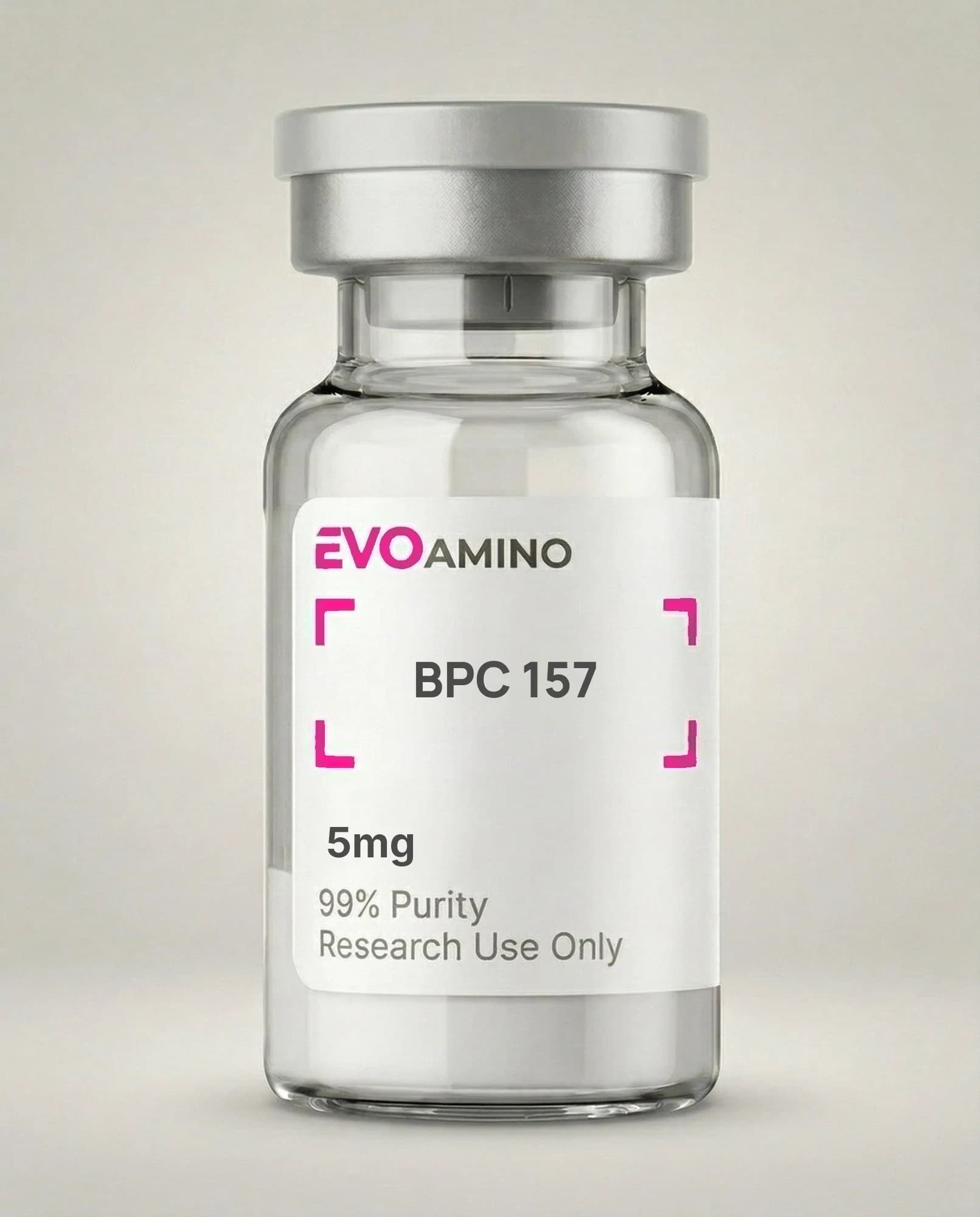
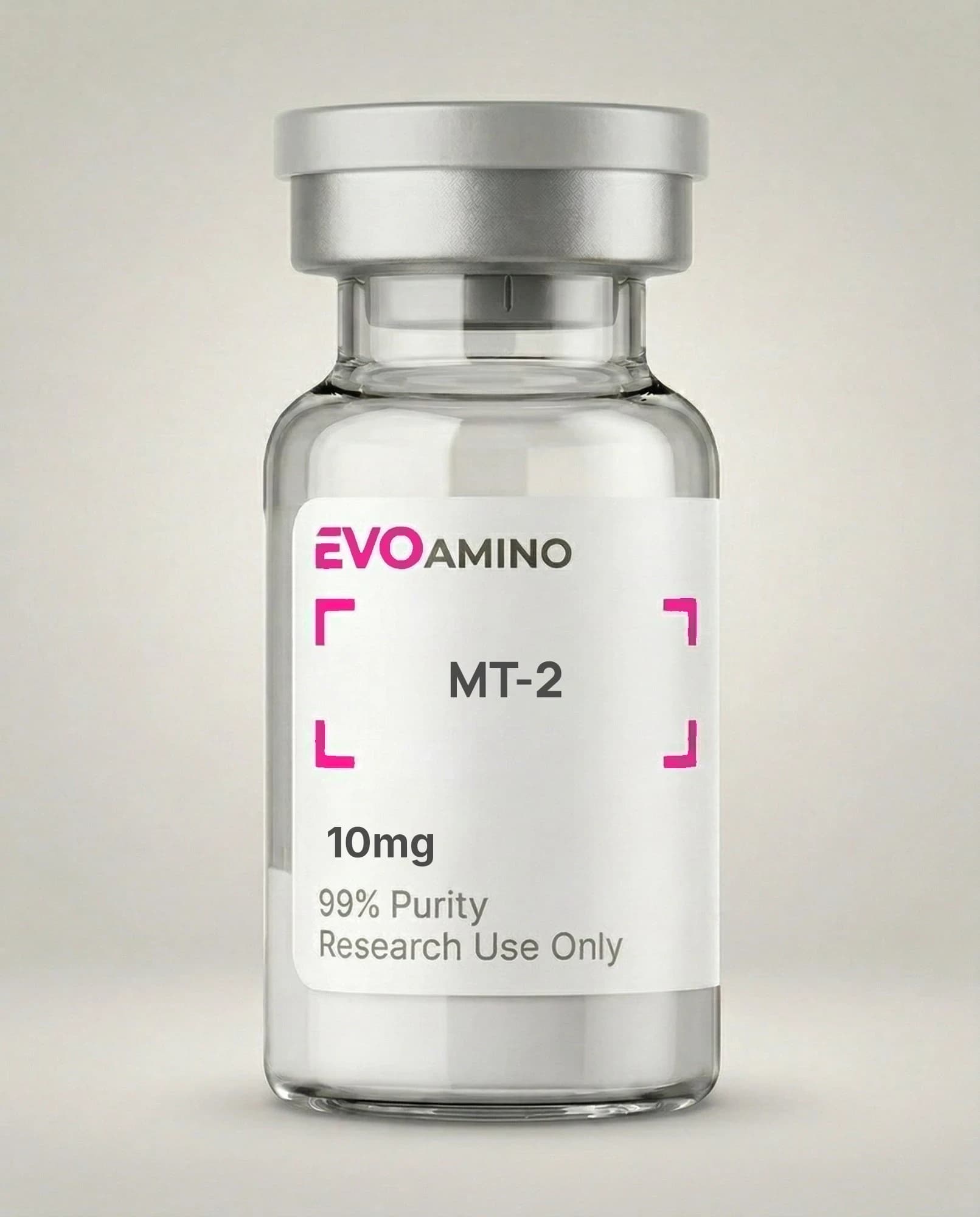
BPC-157 and Melanotan 2 are two synthetic peptides that share almost nothing except a place in research catalogs. BPC-157 is a linear peptide of 15 amino acids described in the literature as a fragment derived from a protein found in gastric juice, hence the name "body protection compound." The Evo Amino catalog lists it with the molecular formula C62H98N16O22, a molecular weight of 1419.56 g/mol, and CAS number 137525-51-0. Melanotan 2 is a cyclic heptapeptide designed as an analog of alpha-melanocyte-stimulating hormone (alpha-MSH). The catalog lists it with the formula C50H69N15O9, a molecular weight of 1024.18 g/mol as the free base, and CAS number 121062-08-6.
The two compounds come from different origins, have different structures, and are studied in different experimental systems. A comparison is useful mainly because researchers sometimes meet both in the same supplier catalog and want to understand why they are classified so differently. This article sets out the differences in origin, structure, pathway research, and analytical handling. It is a reference comparison for laboratory research only.
Comparison table
| Property |
BPC-157 |
Melanotan 2 |
| Origin |
Fragment described from a gastric protein |
Designed analog of alpha-MSH |
| Architecture |
Linear, 15 residues |
Cyclic heptapeptide, lactam bridge |
| Molecular formula |
C62H98N16O22 |
C50H69N15O9 |
| Molecular weight |
1419.56 g/mol |
1024.18 g/mol (free base) |
| CAS number |
137525-51-0 |
121062-08-6 |
| Primary research area |
Cell migration, angiogenesis, tissue models |
Melanocortin receptor pharmacology |
| Supplied form |
Lyophilized, stored at -20 C |
Lyophilized, stored at -20 C |
| Approved pharmaceutical product |
None |
None |
Molecular facts are from the Evo Amino catalog entries for each compound.
How does their origin differ?
BPC-157 is described in the research literature as a partial sequence of a larger protein isolated from human gastric juice. The idea behind that origin is that a stable fragment of a naturally occurring protein might retain a defined activity in simplified experimental systems. The fragment itself is synthetic, and it is generally studied as a purely chemical entity rather than as a purified natural product.
Melanotan 2 has a deliberately engineered origin. It was designed at the University of Arizona as a modification of alpha-MSH, the 13-residue endogenous peptide that activates melanocortin receptors. The design strategy combined truncation to the core receptor-binding region, substitution of a norleucine for methionine, inclusion of a D-phenylalanine, and cyclization through a lactam bridge. Every one of those choices was made to improve stability and potency relative to the native hormone. The result is a molecule whose structure can be traced step by step to a specific design rationale, which is rarely the case for a fragment named after its source.
How do the structures compare?
Structure is the sharpest contrast. BPC-157 is linear and flexible. A chain of 15 residues has many accessible conformations in solution, and the research literature generally treats its behavior as arising from sequence features rather than a fixed three-dimensional shape. Its molecular weight of 1419.56 g/mol is typical for a peptide of that length.
Melanotan 2 is smaller by weight at 1024.18 g/mol but far more constrained. The lactam bridge, an amide bond between the side chains of an aspartate and a lysine, closes a ring through the core His-D-Phe-Arg-Trp motif that melanocortin receptors recognize. Closing the ring locks the core into a conformation resembling the receptor-bound turn of the linear hormone. The bridge is chemically stable and, unlike a disulfide, does not carry redox sensitivity. The inclusion of a D-amino acid further changes how the peptide interacts with proteolytic enzymes, a property noted in the stability literature for D-substituted peptides generally.
In short, one compound relies on a long flexible sequence and the other relies on a short rigid one. That difference shapes both how each is studied and how each is analyzed.
What pathways does published research examine for each?
For BPC-157, published research is concentrated in preclinical models. Reports describe work on endothelial cell behavior and angiogenesis markers, cell migration in scratch-type assays, and signaling readouts such as growth factor receptor expression and nitric oxide pathway components in cultured cells and rodent tissue models. The literature on this compound is dominated by a small number of research groups, and independent replication in controlled human studies is limited. A careful reader treats the pathway descriptions as hypotheses reported in preclinical systems rather than established mechanisms.
For Melanotan 2, the research framework is receptor pharmacology. The compound is characterized as a potent agonist across several melanocortin receptor subtypes, with the receptor-binding and functional assays measuring cyclic AMP accumulation in cells expressing individual receptor subtypes. Work on melanocortin 1 receptor signaling in melanocyte models and on melanocortin 4 receptor signaling in neural tissue models is common. The pharmacology is better defined at the receptor level than the pathway literature on BPC-157, because the molecular target family is established and the assays are standardized.
The two compounds therefore sit at different points of evidence maturity. One has a defined receptor family and a clear design lineage. The other has a body of reported cellular observations without a single agreed-upon receptor target.
How do analytical considerations differ?
Both compounds are supplied as lyophilized solids stored at -20 C, and both need protection from moisture. Beyond that, analysis diverges.
BPC-157, as a linear 15-mer, gives a conventional reverse-phase HPLC profile. The main analytical questions are the usual ones for synthetic peptides of that length: deletion sequences, truncated products, and residual protecting-group adducts from solid-phase synthesis. Electrospray mass spectrometry typically shows multiply charged ions, and the observed mass is compared against the theoretical value from the formula.
Melanotan 2 raises a specific question that BPC-157 does not: confirming the ring closure. The uncyclized linear precursor differs in mass from the cyclized product by one water molecule, 18 Da, and the two can be resolved by mass spectrometry. Because the compound contains tryptophan, it also absorbs strongly at 280 nm and is typically protected from light, whereas BPC-157 does not carry that specific concern. The D-phenylalanine in Melanotan 2 additionally makes stereochemical purity a relevant check, since an epimer can nearly co-elute with the intended product on a standard column.
A certificate of analysis that reports observed versus theoretical mass alongside an HPLC purity trace confirms identity for either compound. The questions it must answer are different, though, and a reader should check whether a certificate addresses the structural features specific to the compound it describes.
What does the evidence picture look like for each?
Neither compound has an approved pharmaceutical product. That shared status is where the similarity ends. Melanotan 2 sits next to a closely related analog, Melanotan 1, which does have an approved pharmaceutical form in some jurisdictions, and a metabolite-derived relative, which has been through regulated clinical development. That surrounding context gives the melanocortin literature a controlled backbone. BPC-157 has no such neighbor. Its literature is largely preclinical and concentrated in a narrow set of laboratories, and review articles on it consistently note the lack of rigorous human data.
For a researcher choosing between the two for an experimental design, the evidence picture is a practical consideration. A study built on Melanotan 2 can lean on well-characterized receptor assays and a large comparative literature on melanocortin ligands. A study built on BPC-157 would need to establish its own readouts and treat prior reports as starting points to be independently confirmed.
Which questions does a comparison like this answer?
A side-by-side view helps with three kinds of decisions. First, it clarifies whether a compound's classification matches its structure: these two are often listed in the same catalog but belong to completely different research traditions. Second, it highlights which analytical checks a certificate of analysis ought to cover for each. Third, it frames expectations about evidence: a defined receptor target and design lineage on one side, a preclinical observation record on the other.
It does not rank the compounds, and nothing in this comparison implies that one is better than the other. They answer different questions in different systems.
Research use only
All compounds discussed in this article, including BPC-157 and Melanotan 2, are supplied strictly for laboratory research purposes. They are not intended for human or veterinary use, and nothing in this article is a recommendation about any compound or any activity. For research purposes only.