* These statements have not been evaluated by the Food and Drug Administration. This product is not intended to diagnose, treat, cure, or prevent any disease. For research purposes only.
5-Amino-1MQNNMT InhibitorNAD+ MetabolismMetabolic ResearchSmall Molecule Research
5-Amino-1MQ: NNMT Inhibition, NAD⁺ Metabolism, and Research Overview
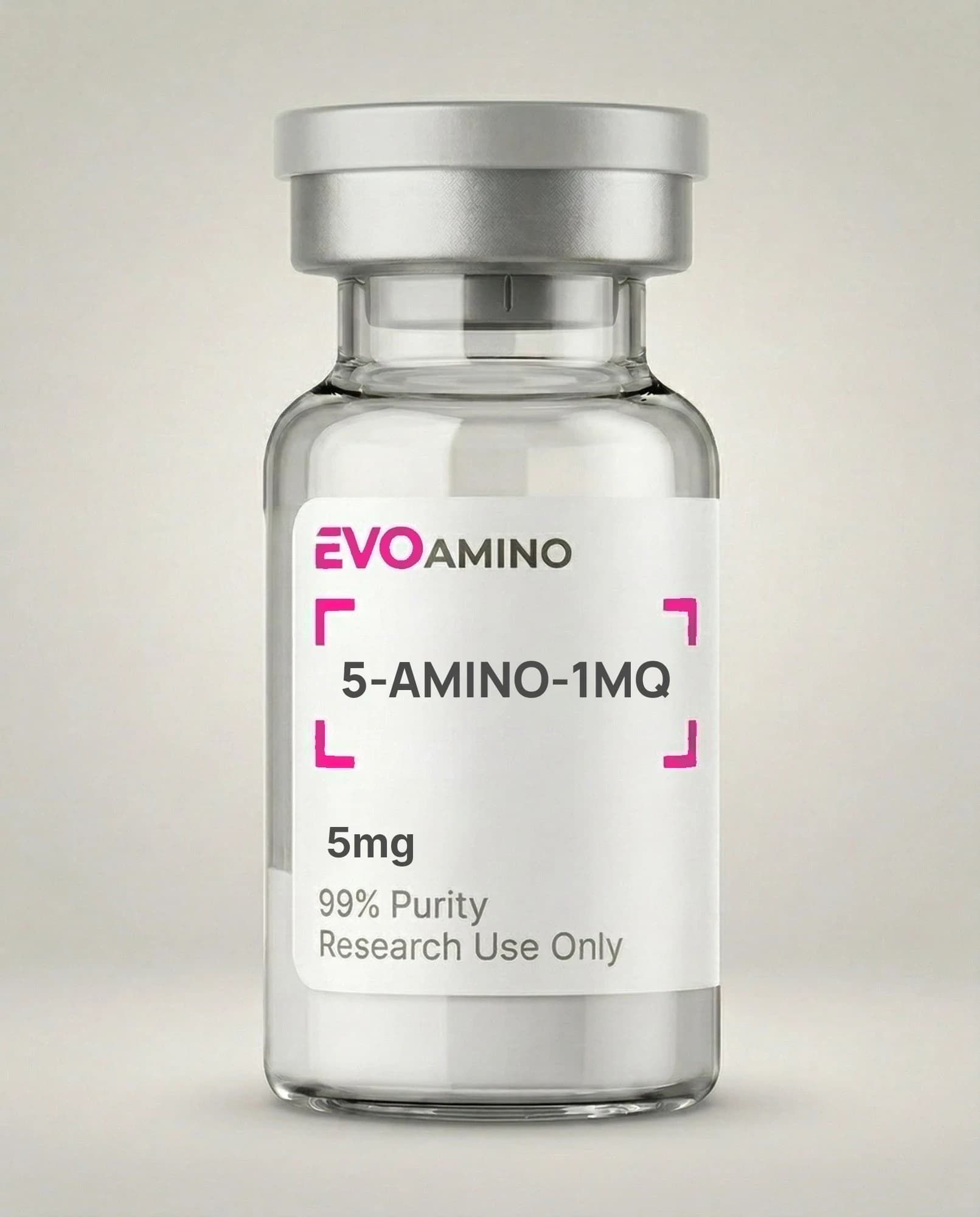
5-Amino-1MQ (5-amino-1-methylquinolinium) is a small-molecule compound studied in research as a selective inhibitor of nicotinamide N-methyltransferase (NNMT), an enzyme involved in NAD⁺ metabolism and one-carbon methylation pathways. It is catalogued under CAS number 42464-96-0 with a molecular formula of C₁₀H₁₁N₂ and a molecular weight of 159.21 g/mol (free base). The compound is supplied as a lyophilized powder for laboratory research and is intended solely for research purposes, not for human use.
Unlike the peptide compounds that constitute most of the metabolic research category, 5-Amino-1MQ is a small organic molecule with a quinolinium scaffold. Its research interest lies in the intersection of enzyme inhibition biochemistry, NAD⁺ homeostasis, and adipose tissue biology—three areas that have converged significantly in the published metabolic research literature over the past decade.
What is the molecular structure of 5-Amino-1MQ?
5-Amino-1MQ has a molecular weight of 159.21 g/mol and the molecular formula C₁₀H₁₁N₂. Its structure is built on a quinolinium ring system—a bicyclic aromatic scaffold consisting of a benzene ring fused to a pyridinium ring—with a methyl group at the ring nitrogen (N1) and an amino group (–NH₂) at the 5 position of the ring. The N1-methyl group makes the ring nitrogen permanently quaternary, which contributes to the compound's polarity and its selectivity profile as an enzyme inhibitor.
The amino group at position 5 is the key pharmacophoric element that confers selectivity for NNMT over related methyltransferase enzymes. Research on the structure-activity relationships of quinolinium-based NNMT inhibitors identifies the 5-amino substitution as critical for potency and selectivity relative to other methyltransferases in the same enzyme superfamily. The compound is characterized to a purity specification of ≥99.3% by HPLC in the research-grade form.
What is NNMT and why is it studied in metabolic research?
Nicotinamide N-methyltransferase (NNMT) is an enzyme that catalyzes the transfer of a methyl group from S-adenosylmethionine (SAM) to nicotinamide, producing N1-methylnicotinamide (MNAM) and S-adenosylhomocysteine (SAH). This reaction sits at the intersection of two significant metabolic processes: it consumes methyl donors from the SAM pool, which is the primary cellular methylation currency, and it diverts nicotinamide away from the biosynthetic pathway that produces NAD⁺ via nicotinamide phosphoribosyltransferase (NAMPT).
NNMT is highly expressed in white adipose tissue, liver, and skeletal muscle and is upregulated in obesity and diet-induced metabolic disease models in published research. Because it competes with NAD⁺ biosynthesis for the same nicotinamide substrate while simultaneously depleting methyl donor availability, NNMT has been characterized in the research literature as a metabolic mediator whose activity level influences both NAD⁺ homeostasis and one-carbon metabolism simultaneously. For a broader overview of metabolic research compounds, see our metabolic peptides guide.
How does 5-Amino-1MQ inhibit NNMT?
Published research characterizes 5-Amino-1MQ as a competitive inhibitor of NNMT with respect to the nicotinamide substrate. The quinolinium ring system of 5-Amino-1MQ structurally resembles the nicotinamide substrate (itself a pyridinium compound), which allows it to occupy the nicotinamide-binding site of the NNMT enzyme active site. By competing with nicotinamide for that site, the compound prevents the methylation reaction from proceeding.
The selectivity of 5-Amino-1MQ for NNMT over other SAM-dependent methyltransferases has been characterized in enzyme panel studies. The structural features that differentiate NNMT's nicotinamide-binding pocket from those of other methyltransferases create a selectivity window that the quinolinium scaffold, particularly with the 5-amino substitution, is well-positioned to exploit. Research on competitive inhibition kinetics has been used to characterize the inhibitory constant (Ki) of the compound in in vitro enzyme assays.
What does published research describe about 5-Amino-1MQ and NAD⁺ metabolism?
Published research describes 5-Amino-1MQ's effects on NAD⁺ levels through its blockade of the competing NNMT-mediated nicotinamide methylation pathway. When NNMT is inhibited, a greater proportion of intracellular nicotinamide is available for conversion to NAD⁺ via the NAMPT-dependent salvage pathway. Cell culture studies in metabolic disease models have documented elevated intracellular NAD⁺ concentrations following NNMT inhibition, consistent with the mechanistic prediction.
The compound differs from NAD⁺ precursors such as nicotinamide riboside (NR) or nicotinamide mononucleotide (NMN) in its mechanism: rather than directly supplying substrate for NAD⁺ synthesis, it reduces the competing pathway that consumes that substrate. Research that examines these two approaches in parallel—precursor supplementation versus NNMT inhibition—treats them as complementary mechanisms that converge on the same NAD⁺ homeostasis endpoint through distinct pharmacological routes. Evo Amino does not make therapeutic or outcome claims regarding 5-Amino-1MQ; it is studied solely for its effects on these enzyme and metabolic pathways in research settings.
How does 5-Amino-1MQ relate to adipogenesis research?
NNMT's expression level in white adipose tissue has made it a subject of adipogenesis research, and 5-Amino-1MQ's inhibitory activity has been studied in that context. Adipogenesis—the differentiation of preadipocytes into mature fat-storing cells—involves PPAR-γ-dependent transcriptional programming that is sensitive to the cellular methylation environment. Published research on NNMT inhibition in adipocyte models has characterized effects on preadipocyte differentiation and the transcriptional markers associated with mature adipocyte identity.
The NAD⁺-raising component of NNMT inhibition is studied separately from the methylation-preserving component in some experimental designs, because these two downstream effects can influence distinct aspects of adipocyte biology. Research models that distinguish between these pathways use NNMT inhibition as a tool to probe the relative contributions of NAD⁺ availability and methyl donor availability to adipogenic transcription programs. These findings are interpreted at the level of cellular signaling in isolated model systems, not as evidence of clinical or therapeutic outcomes.
How does 5-Amino-1MQ differ from NAD⁺ precursor compounds?
The distinction between 5-Amino-1MQ and direct NAD⁺ precursors is mechanistically significant for research design. Precursor compounds such as NMN or NR enter the NAD⁺ biosynthetic pathway as direct substrates, bypassing upstream rate-limiting steps. 5-Amino-1MQ, by contrast, acts upstream at an enzyme that competes with NAD⁺ biosynthesis, effectively increasing the flux of endogenous nicotinamide toward NAD⁺ synthesis without adding exogenous substrate.
Property
NAD⁺ Precursors (NMN, NR)
5-Amino-1MQ
Mechanism class
Substrate supplementation
Enzyme inhibition
Target
NAMPT/NRK salvage pathway
NNMT active site
NAD⁺ effect
Direct substrate for NAD⁺ synthesis
Redirects endogenous nicotinamide to salvage pathway
Methyl donor effect
Neutral (no SAM involvement)
Preserves SAM pool by blocking NNMT methylation
Compound class
Nucleotide precursors
Small-molecule quinolinium inhibitor
Researchers studying NAD⁺ metabolism can use this mechanistic distinction to design experiments that probe different points of the pathway. Evo Amino's catalog includes NAD⁺ as a separate research compound for studies requiring direct NAD⁺ availability in experimental systems, complementing the upstream inhibitor approach of 5-Amino-1MQ.
What is known about 5-Amino-1MQ stability and handling in research?
5-Amino-1MQ is supplied as a lyophilized powder and is stored at −20°C to preserve stability. As a quaternary ammonium compound, it is hygroscopic and should be protected from moisture in storage. Research handling practices that support reproducibility include using appropriate desiccant storage, minimizing exposure of the dry powder to humidity, and protecting the compound from light where photosensitivity is a concern in the specific experimental context.
The compound's small-molecule nature distinguishes its handling from peptide compounds in the same catalog. 5-Amino-1MQ does not carry the disulfide-bridge sensitivity that affects compounds like AOD9604, but humidity management remains relevant for maintaining quantitative accuracy in solution preparation. This article does not provide reconstitution or preparation instructions; handling protocols are determined by the researcher according to experimental requirements and applicable regulations.
How does Evo Amino source 5-Amino-1MQ?
Evo Amino supplies 5-Amino-1MQ as a research-grade compound held to a minimum purity specification of ≥99.3% by HPLC, with identity confirmation. Every batch has a corresponding Certificate of Analysis, and all shipments are packaged from US-based inventory. Researchers can review specifications, available sizes, and pricing on the 5-Amino-1MQ product page, or browse the full metabolic research catalog at all compounds.
All material is intended for laboratory research use only and is not for human use. Evo Amino does not make therapeutic or outcome claims regarding 5-Amino-1MQ or any compound in its catalog. For how a vial connects back to its production lot and the records behind it, see peptide batch traceability.
This compound is a research chemical intended for laboratory and scientific research purposes only. It is not a drug, supplement, or food, and is not intended to diagnose, treat, cure, or prevent any disease. Evo Amino does not sell products intended for human use. Researchers are responsible for compliance with all applicable local, state, and federal regulations.
Stay in the loop
New compounds, research updates & exclusive subscriber deals.