* These statements have not been evaluated by the Food and Drug Administration. This product is not intended to diagnose, treat, cure, or prevent any disease. For research purposes only.
BPC-157NAD+Compound ComparisonResearch Peptides
BPC-157 vs NAD+: A Research Comparison of Peptide and Coenzyme Profiles
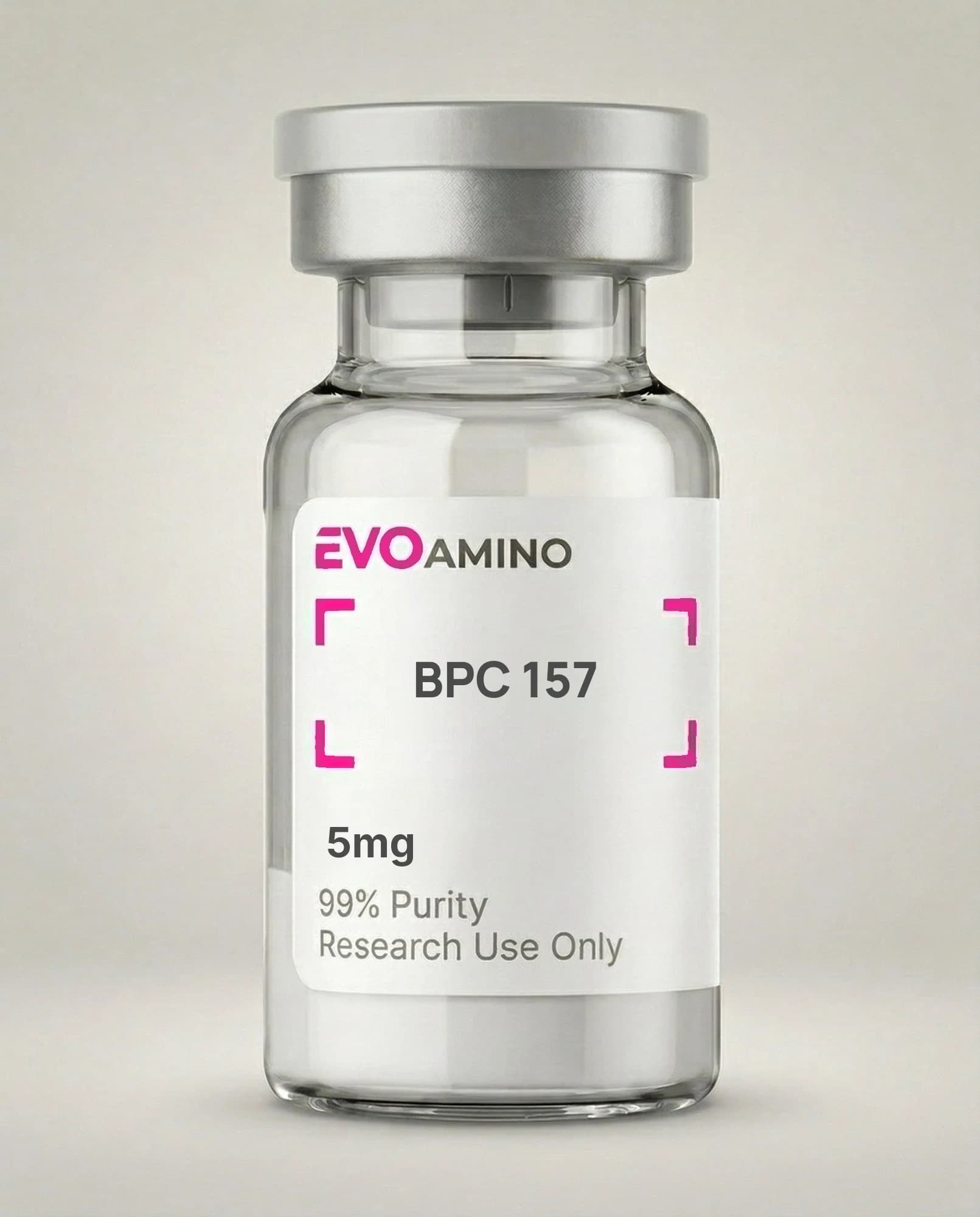
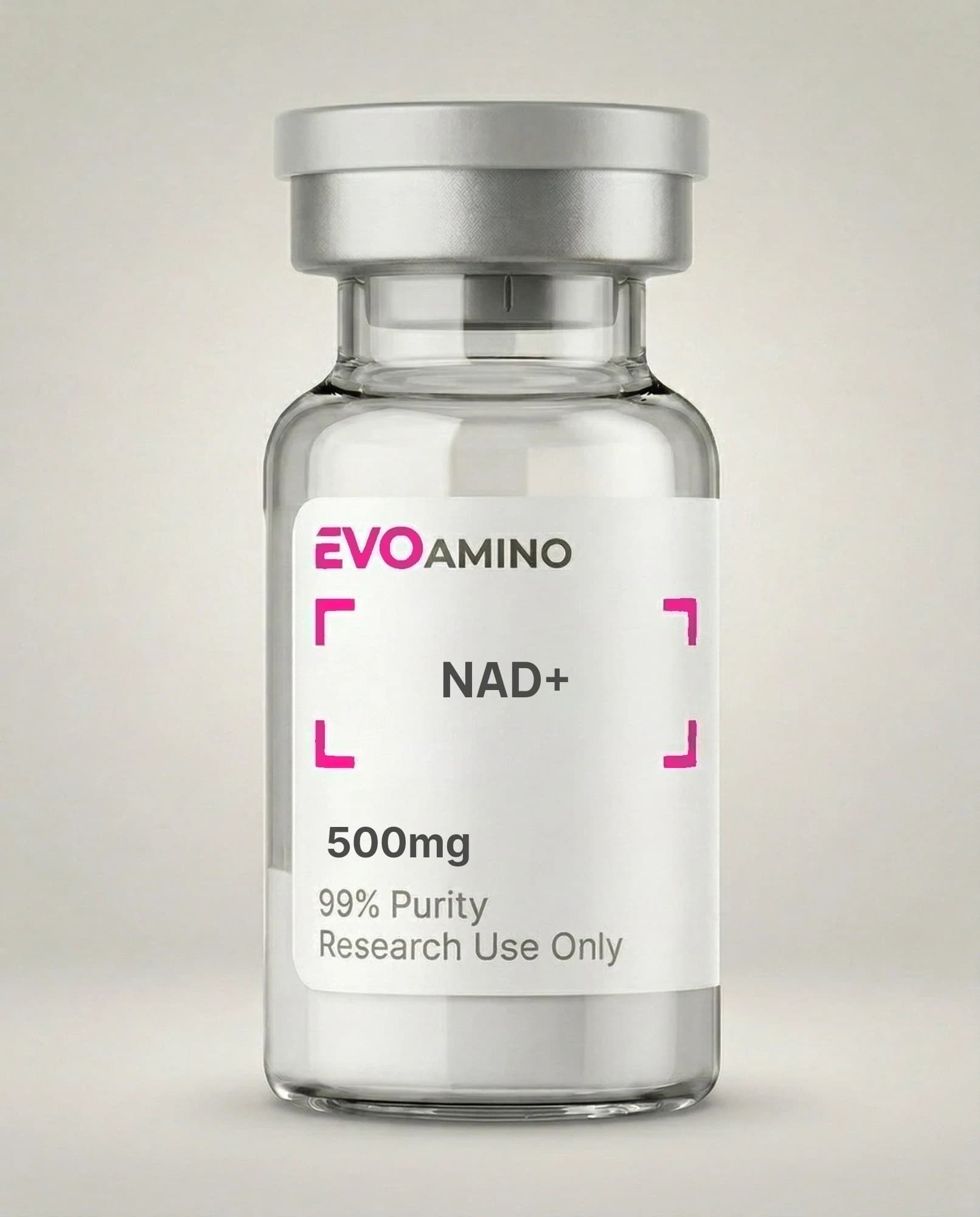
BPC-157 is a synthetic linear peptide of 15 amino acids, described in the research literature as a fragment related to a protein found in gastric juice. NAD+ is nicotinamide adenine dinucleotide, a coenzyme found across living cells and not a peptide at all. Both appear in research catalogs, but they belong to different chemical classes and are studied in different experimental traditions.
The Evo Amino catalog lists BPC-157 with the molecular formula C62H98N16O22, a molecular weight of 1419.56 g/mol, and CAS number 137525-51-0. It lists NAD+ with the formula C21H27N7O14P2, a molecular weight of 663.43 g/mol as the anhydrous free acid, and CAS number 53-84-9. A comparison is useful mainly because researchers meet both in one catalog and want to understand why they are handled and read so differently. This article is a reference comparison for laboratory research only.
Comparison table
Property
BPC-157
NAD+
Chemical class
Linear peptide, 15 residues
Dinucleotide coenzyme
Molecular formula
C62H98N16O22
C21H27N7O14P2
Molecular weight
1419.56 g/mol
663.43 g/mol (anhydrous free acid)
CAS number
137525-51-0
53-84-9
Key linkage
Amide (peptide) bonds
Pyrophosphate bridge between two nucleotides
Primary research area
Cell migration, angiogenesis, tissue models
Redox biochemistry, NAD-dependent enzyme studies
Supplied form
Lyophilized, stored at -20 C
Lyophilized, stored at -20 C
Molecular facts are from the Evo Amino catalog entries for each compound.
How does the chemistry differ?
The two molecules are built from different parts. BPC-157 is a chain of amino acids joined by amide bonds, so its identity is defined by a sequence of 15 residues. Its nitrogen-rich formula, with 16 nitrogen atoms, reflects that amino acid content.
NAD+ has no sequence. It consists of two nucleotides, one carrying an adenine base and one carrying nicotinamide, joined through their phosphate groups by a pyrophosphate bridge. The two phosphorus atoms in the formula are the signature of that bridge, and they are absent from BPC-157 entirely. The nicotinamide ring is the redox-active part of the molecule, which is why the oxidized form carries a positive charge in its conventional name.
That structural gap sets how each is described. A peptide is described by its residue order and any modifications. A dinucleotide is described by its components and its oxidation state.
What do the molecular weights tell a researcher?
The weight difference is large: 1419.56 g/mol against 663.43 g/mol, which means BPC-157 is a little more than twice as heavy. The two figures also mean different things on a mass spectrometer. For the peptide, electrospray ionization typically produces multiply charged ions, and the observed series is deconvoluted back to a mass. For the dinucleotide, the smaller size and its phosphate groups favor simpler ion patterns, usually read in negative mode.
The catalog's qualifier for NAD+ matters here. The stated weight is for the anhydrous free acid, so a hydrated or salt form of the same coenzyme would report a different weight. A researcher comparing a stated weight with a measured mass should confirm which form is meant. The same discipline is covered in the article on batch traceability, where lot-level identity is what makes a number interpretable.
What research context does each compound have?
For BPC-157, published research is concentrated in preclinical models. Reports describe work on endothelial cell behavior, angiogenesis markers, cell migration in scratch-type assays, and signaling readouts in cultured cells and rodent tissue models. The literature comes from a small number of research groups, and independent replication in controlled human studies is limited. A careful reader treats the pathway descriptions as hypotheses reported in preclinical systems. For deeper detail, see the BPC-157 angiogenesis and endothelial signaling overview.
For NAD+, the research context is long-established biochemistry. It is characterized as a hydride-carrying cofactor in oxidation and reduction reactions, and as a consumed substrate for several enzyme families studied in cell biology, including sirtuin deacylases, poly(ADP-ribose) polymerases, and cyclic ADP-ribose synthases. Those descriptions come from standard biochemistry and enzymology, and the assays are well standardized.
The two sit at different points of evidence maturity. One has a defined role in textbook metabolism, while the other has a body of reported cellular observations without a single agreed-upon receptor or enzyme target. Neither description implies anything about what either material does outside an experimental system.
How do analytical considerations differ?
Both are supplied as lyophilized solids stored at -20 C, and both need protection from moisture. Beyond that, analysis diverges.
BPC-157, as a linear 15-mer, gives a conventional reverse-phase HPLC profile. The main questions are those common to synthetic peptides: deletion sequences, truncated products, and residual protecting-group adducts from solid-phase synthesis. The observed mass is compared with the theoretical value from the formula. The limits of purity numbers in such work are discussed in the article on HPLC co-elution.
NAD+ raises different questions. Its strongly polar, charged structure retains poorly on a standard reverse-phase column, so methods often use ion-pairing or hydrophilic interaction chromatography. The pyrophosphate bridge is the usual point of hydrolysis, and breakdown yields smaller nucleotide fragments such as adenosine monophosphate-related species and nicotinamide. Because the molecule absorbs ultraviolet light through its adenine ring, UV detection is straightforward, but a purity trace alone cannot say whether a reduced or oxidized form is present.
A certificate of analysis that reports observed versus theoretical mass alongside an HPLC trace confirms identity for either material. The questions it must answer differ, so a reader should check whether the certificate addresses the features specific to the compound it describes.
How do storage and stability concerns compare?
The catalog gives both materials the same storage line, minus 20 degrees Celsius in lyophilized form, but the reasons overlap only partly. Dry peptides are generally treated in the literature as vulnerable to moisture uptake, which can plasticize the solid and speed slow degradation. The physical reasoning is set out in the article on moisture uptake and glass transition.
Dinucleotides share the moisture concern, and add a chemistry-specific one: the pyrophosphate linkage is susceptible to hydrolysis when water is present, and the nicotinamide ring is sensitive to conditions that change its oxidation state. Matching storage lines therefore describe a shared logistics outcome, not a shared degradation pathway. A researcher recording both materials in the same freezer should still record them as different stability problems.
Which questions does a comparison like this answer?
A side-by-side view helps with three kinds of decisions. First, it clarifies classification: a peptide and a coenzyme can sit in the same catalog while belonging to different chemistries, with different identifiers, weights, and linkages. Second, it highlights which analytical checks a certificate ought to cover for each. Third, it frames expectations about evidence: an established biochemical role on one side, a largely preclinical observation record on the other.
It does not rank the compounds, and nothing in this comparison implies that one is better than the other. They answer different questions in different systems, and a design that treats them as interchangeable has misread both.
Research use only
The Evo Amino compound guides discussed here are informational resources. All compounds referenced in this article are supplied strictly for laboratory research purposes and are not intended for human or veterinary use, and nothing in this article is a recommendation about any compound or any activity. For research purposes only.
Reference
Common questions
BPC-157 is a linear peptide of 15 amino acids, while NAD+ is a dinucleotide coenzyme built from two nucleotides joined through their phosphate groups. The Evo Amino catalog lists BPC-157 at C62H98N16O22 and NAD+ at C21H27N7O14P2. They belong to different chemical classes, for research reference only.
No. NAD+ is a dinucleotide, a coenzyme assembled from nicotinamide and adenine nucleotides, with no peptide bonds in its backbone. It sometimes appears in the same catalogs as research peptides because it is supplied as a lyophilized research material. Its chemistry and analysis follow nucleotide conventions, not peptide ones.
Peptide analysis focuses on sequence-related impurities such as deletions and truncations, while a dinucleotide is assessed for phosphate-linked chemistry and hydrolysis products. Each needs a method suited to its structure. A certificate of analysis should address the features specific to the compound it describes, in a research context.
In the Evo Amino catalog both are listed as lyophilized and stored at minus 20 degrees Celsius. Matching storage lines do not mean matching stability behavior, because a peptide and a dinucleotide degrade through different chemical routes. Moisture protection remains a concern for both dry materials in a research setting.
Stay in the loop
New compounds, research updates & exclusive subscriber deals.