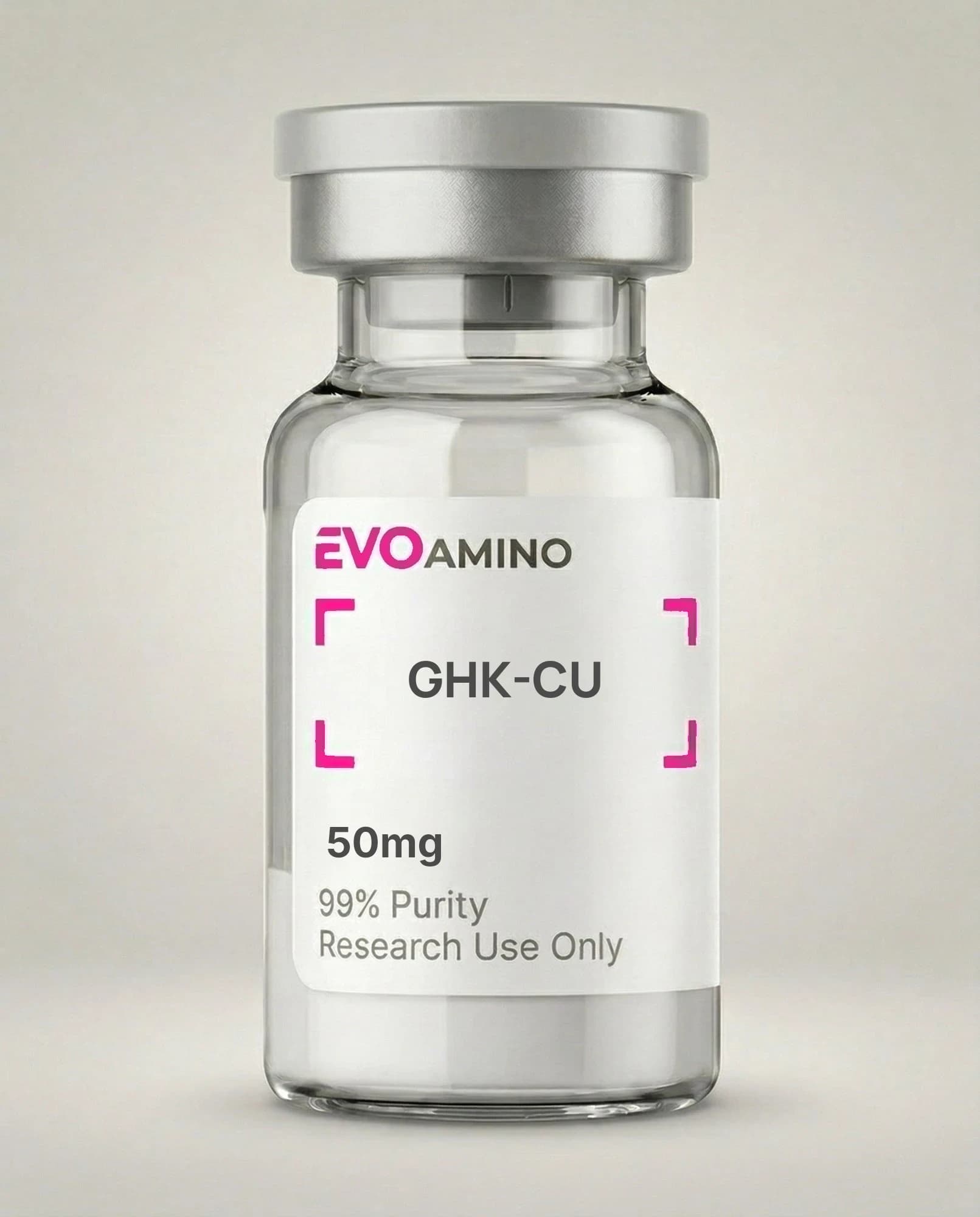
* These statements have not been evaluated by the Food and Drug Administration. This product is not intended to diagnose, treat, cure, or prevent any disease. For research purposes only.
GHK-Cu and Matrixyl are the two most-searched peptides in cosmetic science, and 2026 has only widened the gap between public interest and public understanding. GHK-Cu is in the middle of a genuine popularity wave — the "glow peptide" conversation across social platforms has pushed copper-peptide search demand to record levels — while Matrixyl has spent two decades as the workhorse ingredient of the anti-aging cosmetics industry. Both are peptides, both are studied in fibroblast and skin models, and both appear in the same product-comparison searches. Mechanistically, however, they are almost perfect opposites: one is a metal-delivery signal that modulates dozens of pathways, the other is a single-purpose collagen-feedback mimic. This comparison lays out what the published research actually characterizes for each, for researchers deciding which compound fits a given experimental question. As with everything in this space, both compounds are discussed here strictly as research materials studied in laboratory models — nothing below is guidance for personal use of any kind.
What are the structural differences?
GHK-Cu is a naturally occurring tripeptide — glycyl-L-histidyl-L-lysine — complexed with a copper(II) ion. The parent peptide was isolated from human plasma in the early 1970s by Loren Pickart, who observed that plasma fractions from young donors altered the behavior of aged tissue preparations. The histidine imidazole and the amino-terminal nitrogen coordinate the copper ion with high affinity, making GHK one of the body's characterized copper-transport motifs. Its plasma concentration declines substantially with age — a data point that anchors much of the aging-research interest in the compound.
Matrixyl is the trade name for palmitoyl pentapeptide-4 (pal-KTTKS): a five-amino-acid fragment — lysine-threonine-threonine-lysine-serine — of the carboxy-terminal propeptide of type I procollagen, conjugated to a sixteen-carbon palmitic-acid tail. The KTTKS sequence is a matrikine: a signaling fragment released when extracellular-matrix proteins are degraded. The palmitoyl tail is a delivery modification, added to increase the lipophilicity of an otherwise highly polar peptide.
The structural contrast frames everything downstream: a compact metal complex versus a lipidated protein fragment; an evolved transport peptide versus an engineered cosmetic ingredient built around a natural signal.
How do their mechanisms differ in published research?
GHK-Cu's research literature describes a broad, multi-pathway profile. In fibroblast culture, published studies have characterized increased synthesis of collagen, elastin precursors, and glycosaminoglycans following GHK-Cu exposure. The copper payload connects the peptide to cuproenzyme biology — lysyl oxidase, which cross-links collagen and elastin, and superoxide dismutase both require copper. Beyond matrix synthesis, Pickart's group and others have published gene-expression profiling reporting that GHK exposure shifts the expression of a remarkably large number of genes in cultured cells, including upregulation of tissue inhibitors of metalloproteinases (TIMPs) — the endogenous brakes on collagen-degrading MMP enzymes. The breadth of this profile is exactly why researchers treat GHK-Cu as a systems-level modulator in skin models rather than a single-target reagent, and why isolating which effects are copper-dependent versus peptide-dependent remains an active experimental question.
Matrixyl's characterized mechanism is narrower and cleaner. As a fragment of the procollagen propeptide, KTTKS participates in the collagen feedback loop: published fibroblast studies describe pal-KTTKS stimulating synthesis of collagen I and III and fibronectin, with the signaling framed through TGF-beta-associated pathways. The compound essentially impersonates a degradation signal — telling fibroblasts that matrix has been lost and production should rise. Its research use is correspondingly focused: it is the standard positive-control matrikine for collagen-synthesis assays in dermal fibroblast culture.
What does the delivery and penetration literature say?
Topical-delivery research treats the two compounds very differently. The often-cited ~500 Da guideline for passive dermal penetration puts GHK-Cu (a small tripeptide complex near that threshold) in plausible range for topical study designs, and published permeation work with copper peptides reflects that. KTTKS alone is polar and penetrates poorly — which is precisely why the palmitoylated form exists. Published dermal-stability and permeation studies comparing KTTKS and pal-KTTKS report that the palmitoyl modification improves skin permeation while the peptide remains subject to enzymatic degradation in skin homogenates, and more recent formulation research has examined liposomal encapsulation of pal-KTTKS to further protect and deliver the sequence. For researchers, the practical read is that formulation is a first-order variable for both compounds: permeation-model results are formulation results, not bare-peptide results.
What does the clinical-cosmetic study record look like?
Both compounds have human cosmetic-study literature, and both records should be read with their limitations in view.
The landmark Matrixyl study remains Robinson and colleagues' 2005 twelve-week, double-blind, placebo-controlled trial of topical pal-KTTKS in 93 female subjects with photoaged facial skin, which reported statistically significant improvements in wrinkle-depth parameters versus vehicle by quantitative profilometry. It is one of the most-cited clinical investigations in the cosmetic-peptide field, and its design — vehicle-controlled, instrument-measured — is the benchmark later ingredient studies are compared against.
GHK-Cu's cosmetic-trial record consists of multiple smaller placebo- or vehicle-controlled studies reporting improvements in measured wrinkle and skin-parameter endpoints, alongside a much larger preclinical literature on wound and tissue models. Reviews of the field consistently note the same caveats for both compounds: modest sample sizes, short durations, cosmetic rather than clinical endpoints, and frequent industry sponsorship. The honest summary is that both have real, measurable, published effects in cosmetic study models — and neither has the kind of large, independent, long-duration trial record that would settle the comparative question. Researchers should treat superiority claims in either direction as marketing, not literature.
How do researchers choose between them?
The choice follows the experimental question. Studies probing matrix-synthesis signaling — collagen feedback, TGF-beta pathway readouts, fibroblast activation — typically reach for pal-KTTKS because its mechanism is specific and its assay behavior well-precedented. Studies probing broader remodeling biology — MMP/TIMP balance, cuproenzyme activity, multi-gene expression shifts, wound-model endpoints — use GHK-Cu, accepting its mechanistic breadth as the point rather than a confound. Copper-dependence questions add a clean experimental handle unique to GHK-Cu: parallel arms with apo-GHK versus the copper complex separate peptide signaling from metal delivery.
Comparison-format studies using both compounds in the same fibroblast system are increasingly common in the cosmeceutical literature, reflecting the same head-to-head interest driving public search demand. For that design, the compounds' different solubility and stability profiles matter: as always, researchers should confirm identity and purity against the batch Certificate of Analysis for each lot rather than relying on nominal values.
What's the bottom line for researchers?
GHK-Cu and Matrixyl answer different questions. GHK-Cu is a naturally occurring copper-delivery tripeptide with a broad, systems-level research profile spanning matrix synthesis, protease regulation, and gene expression — currently enjoying a surge of public attention that has outrun the pace of new controlled data. Matrixyl is an engineered collagen-fragment mimic with one well-characterized job and the strongest single clinical-cosmetic study in the category. Neither compound's popularity changes its evidentiary status, and the current copper-peptide wave is a reason for more careful reading of the literature, not less. Evo Amino supplies GHK-Cu as a research compound for laboratory use only — it is not intended for human use, and no cosmetic or therapeutic outcome is implied for any research material discussed here.
Cited literature
References
Primary literature and public databases referenced above. Each link resolves on the publisher or database of record.