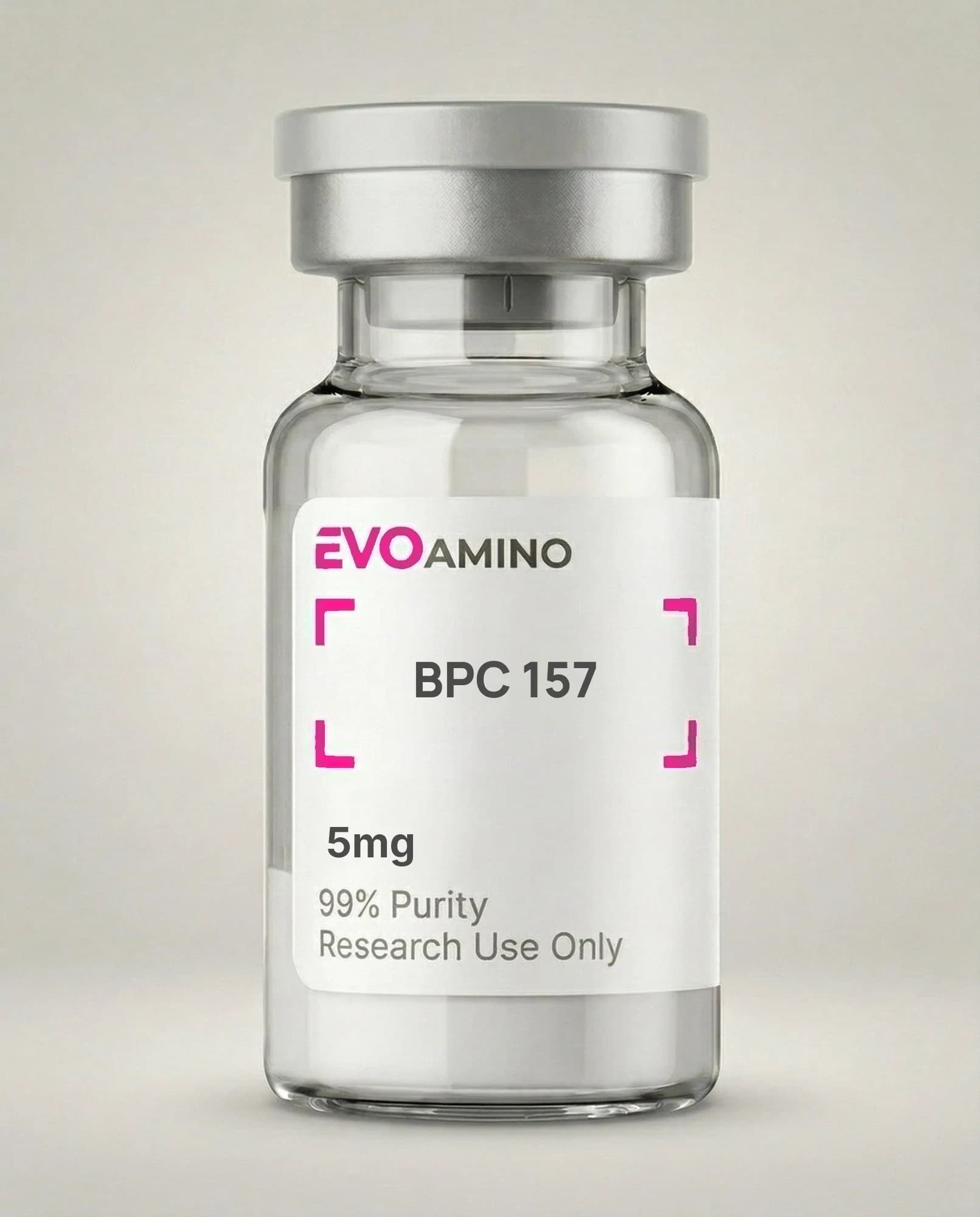
* These statements have not been evaluated by the Food and Drug Administration. This product is not intended to diagnose, treat, cure, or prevent any disease. For research purposes only.
How do BPC-157 and Follistatin differ as research compounds?
BPC-157 and Follistatin are both frequently referenced in tissue-repair and growth-factor research, but they belong to entirely different molecular classes, act through unrelated mechanisms, and are studied for distinct reasons. BPC-157 is a short synthetic peptide with a distributed, multi-pathway signaling profile; Follistatin is a large secreted glycoprotein that works as a targeted ligand-neutralizing antagonist. Investigators sometimes group the two together because both appear in muscle and connective-tissue research literature, but the underlying biology is not comparable in any direct sense.
This guide compares the two compounds across molecular class and origin, primary structure, mechanism of action, receptor/target biology, and documented in vitro research applications — a side-by-side intended to clarify what each compound is actually suited to answer in a research design, not to suggest they are interchangeable tools.
Molecular Class: Synthetic Cytoprotective Peptide vs Secreted Antagonist Glycoprotein
The starting point for this comparison is that BPC-157 and Follistatin are not the same kind of molecule at all.
BPC-157 is a synthetic cytoprotective pentadecapeptide — a 15-amino-acid linear peptide derived from a partial sequence of human gastric juice protein, first isolated from gastric mucosal tissue. It has no single fully characterized receptor; its documented effects in published research are described as arising from engagement across several signaling pathways simultaneously, including nitric oxide signaling and growth-factor cascades.
Follistatin is a secreted glycoprotein, not a short synthetic peptide, encoded by the FST gene and expressed across skeletal muscle, ovary, testis, pituitary, and other tissue types. It circulates in multiple isoforms of differing length arising from alternative splicing and proteolytic processing, most notably the 288-residue (FST288) and 315-residue (FST315) forms. Unlike BPC-157, Follistatin has a precisely defined molecular function: high-affinity, non-competitive binding to ligands of the transforming growth factor-beta (TGF-β) superfamily that physically prevents those ligands from engaging their cell-surface receptors.
These are not two variants of the same research tool. BPC-157 is a small synthetic peptide studied for multi-pathway cytoprotective signaling; Follistatin is a large antagonist protein studied for its capacity to sequester specific growth factors out of a signaling environment.
Primary Structure: A 15-Residue Peptide vs a Multi-Domain Glycoprotein
The structural gap between these two compounds is substantial.
BPC-157 is a 15-residue linear peptide with the sequence Gly-Glu-Pro-Pro-Pro-Gly-Lys-Pro-Ala-Asp-Asp-Ala-Gly-Leu-Val. Molecular formula: C₆₂H₉₈N₁₆O₂₂. Molecular weight: 1419.56 g/mol. CAS number: 137525-51-0. Its defining structural feature is a Pro-Pro-Pro triplet at positions 3–5 plus a fourth proline at position 8, a polyproline-rich stretch that imposes conformational rigidity on the backbone. No cysteine residues are present, so no disulfide bonds form — a structural simplicity that distinguishes it sharply from Follistatin.
Follistatin is a multi-domain glycoprotein rather than a short peptide chain, so its "structure" is described in domains rather than a residue-by-residue sequence. The mature protein contains an N-terminal domain (ND) that makes primary contact with ligand, followed by three tandem cysteine-rich follistatin domains (FSD1, FSD2, FSD3), each stabilized by intramolecular disulfide bonds. Molecular weight ranges from approximately 37,000–40,000 Da for the recombinant glycosylated forms down to roughly 3,780 Da for a synthetic truncated form limited to the core domain architecture; the formula is not expressed as a fixed small-molecule formula given the protein's size and glycosylation variability. CAS number: 117628-82-7. Published crystallographic studies show Follistatin physically wraps around a bound ligand dimer, occluding both type I and type II receptor-binding surfaces in what structural literature describes as a "molecular cage" geometry.
At the structural level: BPC-157 is a small, rigid, proline-constrained peptide with no single characterized receptor pharmacophore; Follistatin is a large, disulfide-stabilized, multi-domain protein engineered by evolution to physically encircle its target ligands.
Mechanism of Action: Distributed Multi-Pathway Signaling vs Stoichiometric Ligand Sequestration
The mechanistic contrast follows directly from the structural one.
BPC-157 does not act through a single defined receptor. Published in vitro work documents effects distributed across several systems: nitric oxide pathway activity (endothelial nitric oxide synthase and downstream cGMP signaling in endothelial cell culture), growth-factor signaling (VEGF expression, FGF-2 receptor activity, and EGF receptor phosphorylation characterized in fibroblast and epithelial models), and neurotransmitter system effects in neuronal cultures. This mechanistic breadth is treated in published reviews as a defining feature of BPC-157's research profile rather than a gap in characterization.
Follistatin acts through a single, well-defined mechanism: stoichiometric, non-competitive neutralization of its target ligands. Because the follistatin domain array binds both subunits of a dimeric ligand — most notably activin A and myostatin (GDF-8) — in one binding event, one Follistatin molecule occupies the receptor-binding surfaces of one ligand dimer without needing to compete with the receptor itself. In cell-culture models, this is used to suppress SMAD2/3 phosphorylation downstream of activin or myostatin stimulation, giving researchers a way to isolate the contribution of those specific ligands to an observed phenotype.
Mechanistically, BPC-157 is a distributed multi-pathway modulator engaging systems that remain to be fully receptor-mapped; Follistatin is a precision antagonist whose single mechanism — physical ligand occlusion — is comparatively simple to describe but highly specific in its targets.
Target Biology: Uncharacterized Multi-System Engagement vs Defined TGF-β Superfamily Antagonism
This distinction shapes what each compound can be used to ask in a research design.
BPC-157's upstream receptor, or receptors, have not been fully identified in published literature, even though its downstream effects in cell culture are reproducible and well documented. This positions BPC-157 as a tool for studying downstream pathway effects — nitric oxide signaling, growth-factor cascades, cytoprotective and cell-migration phenotypes — without a single defined binding target to characterize directly.
Follistatin's targets are precisely mapped: activin A, activin B, and myostatin are its highest-affinity ligands, with documented lower-affinity binding to GDF-11 and several bone morphogenetic proteins (BMP-2, BMP-4, BMP-7). Each of these ligands signals through ACVR2A/ACVR2B-type II receptor complexes that recruit type I receptors and drive SMAD2/3 phosphorylation — a canonical TGF-β superfamily cascade that Follistatin interrupts at the ligand level rather than the receptor level. Because Follistatin's binding affinities and selectivity profile across these ligands are well characterized, it functions as a precision research tool for isolating activin- and myostatin-dependent signaling from the broader TGF-β superfamily.
Research Applications: Where the Two Appear in the Same Literature
Despite the mechanistic gap, BPC-157 and Follistatin do intersect in one corner of the published research space: tissue-repair and connective-tissue biology, particularly around skeletal muscle and tendon models.
BPC-157 research applications documented in the literature include gastric mucosal epithelial protection models, tendon and connective-tissue fibroblast culture systems, vascular biology and angiogenesis research using endothelial cell models, and neuronal stress-response studies. Its value in these contexts is its multi-pathway engagement — investigators use it to perturb NO signaling, growth-factor cascades, and oxidative stress pathways simultaneously.
Follistatin research applications documented in the literature include skeletal muscle satellite cell cultures, where it is used to define the myostatin-dependent component of myoblast differentiation; granulosa and gonadotroph cell models studying activin's role in FSH regulation; embryonic stem cell differentiation protocols; and cardiac fibrosis research examining activin A's role in tissue remodeling. Its value in these contexts is precision — removing one or two specific ligands from a signaling environment without perturbing unrelated pathways.
The overlap zone is narrow: both compounds appear in published tissue-repair and muscle-biology literature, but BPC-157 is typically the multi-pathway perturbation tool while Follistatin is the ligand-specific antagonist used to isolate a single signaling axis within the same tissue system. A research design that requires broad cytoprotective signaling calls for BPC-157; a design that requires selective activin/myostatin neutralization calls for Follistatin. The two are not substitutes for each other.
All compounds discussed in this article — including BPC-157 and Follistatin — are available from Evo Amino exclusively for in vitro laboratory research purposes. Neither compound is approved for human or animal use, and nothing in this article constitutes a therapeutic claim, dosing guidance, or medical recommendation. All findings cited above derive from published in vitro and preclinical literature. Investigators should review current published literature and consult institutional compliance requirements before initiating any research protocol. For research purposes only.
Stay in the loop
New compounds, research updates & exclusive subscriber deals.