* These statements have not been evaluated by the Food and Drug Administration. This product is not intended to diagnose, treat, cure, or prevent any disease. For research purposes only.
What is ipamorelin and how does it differ from other GH secretagogues?
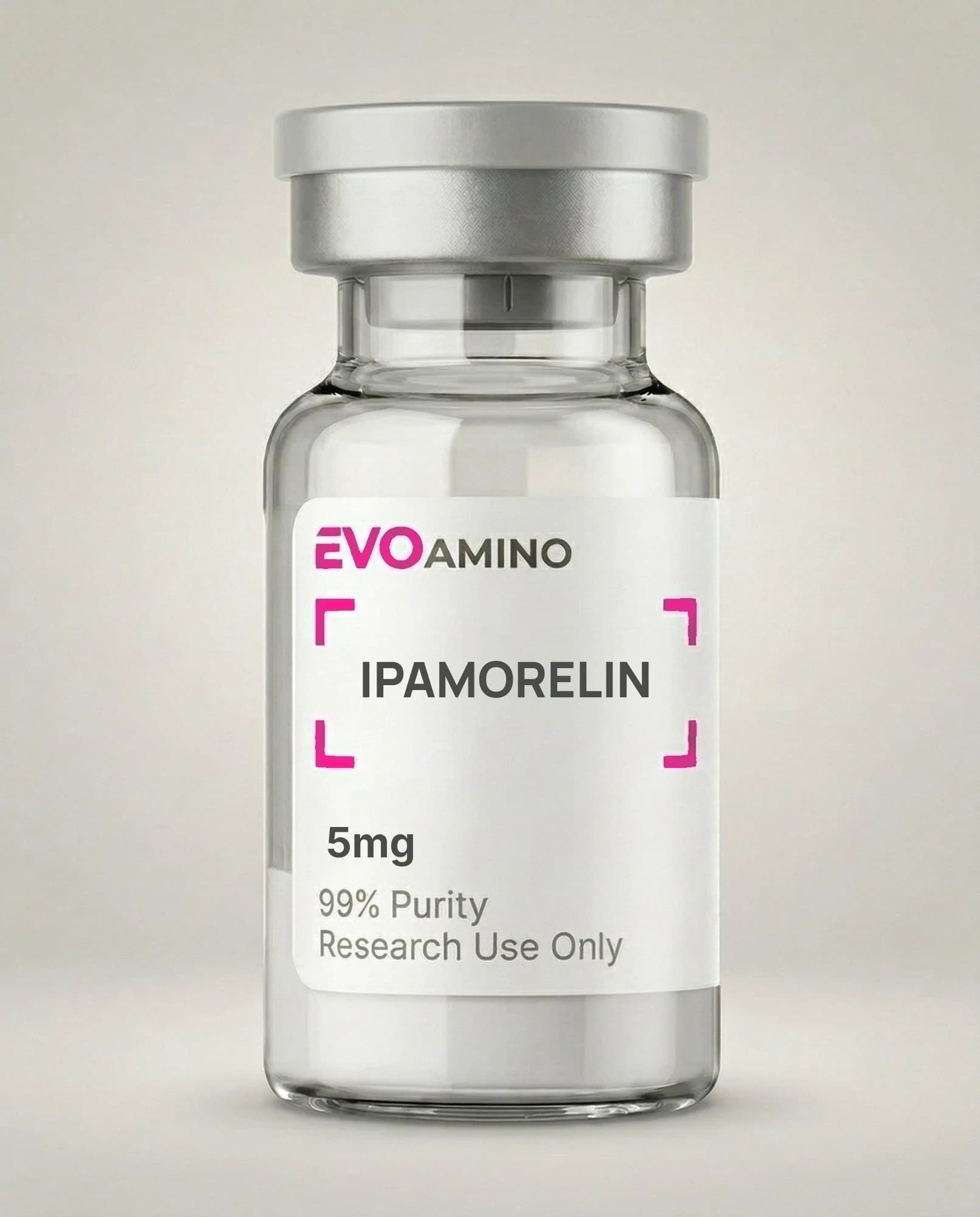
Ipamorelin is a synthetic pentapeptide with the sequence Aib-His-D-2-Nal-D-Phe-Lys-NH₂, the molecular formula C₃₈H₄₉N₉O₅, a molecular weight of 711.9 g/mol, and CAS number 170851-70-4. It belongs to the growth hormone-releasing peptide (GHRP) family and acts as an agonist at the growth hormone secretagogue receptor type 1a (GHS-R1a), the receptor for ghrelin. That places it in a different receptor class from the other secretagogues in Evo Amino's catalog, CJC-1295 no DAC and tesamorelin, which are analogs of growth hormone-releasing hormone (GHRH) acting at the GHRH receptor. The comparison below is organized around that receptor split, because it determines almost everything else: structure, size, mechanism, and how the compounds are studied together. Ipamorelin is supplied as a lyophilized research compound.
How do the receptor classes differ?
Ghrelin mimetics and GHRH analogs stimulate growth hormone release through two separate receptors on pituitary somatotroph cells that converge on the same output. The GHRH receptor is a class B G-protein-coupled receptor signaling through Gs and cyclic AMP. GHS-R1a is a class A receptor signaling predominantly through Gq and intracellular calcium. Because the two pathways are distinct and additive, published pituitary cell studies report that a GHRH analog and a ghrelin mimetic applied together produce a larger growth hormone response than either alone, which is the basis for their frequent pairing in secretagogue research. Ghrelin mimetics are also reported to act partly by opposing somatostatin's inhibitory tone on the somatotroph, a mechanism GHRH analogs do not share.
GH-selective; minimal ACTH, cortisol, prolactin response in published models
GH via GHRH receptor
GH via GHRH receptor
Half-life basis
Short peptide, no lipidation
Short (no albumin-binding DAC moiety)
Extended by N-terminal acylation
Signaling
Gq, calcium
Gs, cAMP
Gs, cAMP
Molecular facts are from the Evo Amino catalog entries for each compound.
What makes ipamorelin selective?
Ipamorelin's selectivity is the property that distinguished it from earlier GHRPs in the published characterization work. GHRP-2 and GHRP-6, the first-generation ghrelin mimetics, were reported in pituitary and animal models to stimulate not only growth hormone but also adrenocorticotropic hormone (ACTH), cortisol, and prolactin. The original ipamorelin characterization reported growth hormone release comparable in magnitude to GHRP-6 with no significant elevation of ACTH, cortisol, or prolactin across the studied range, which is why it is described as a selective secretagogue. Structurally, the selectivity is attributed to the specific combination of the alpha-aminoisobutyric acid at position 1, the D-configured naphthylalanine and phenylalanine, and the C-terminal amide, which together shape the peptide's receptor interaction. The ipamorelin research overview on a sister brand covers the receptor pharmacology in more depth.
How does CJC-1295 no DAC differ from CJC-1295 with DAC?
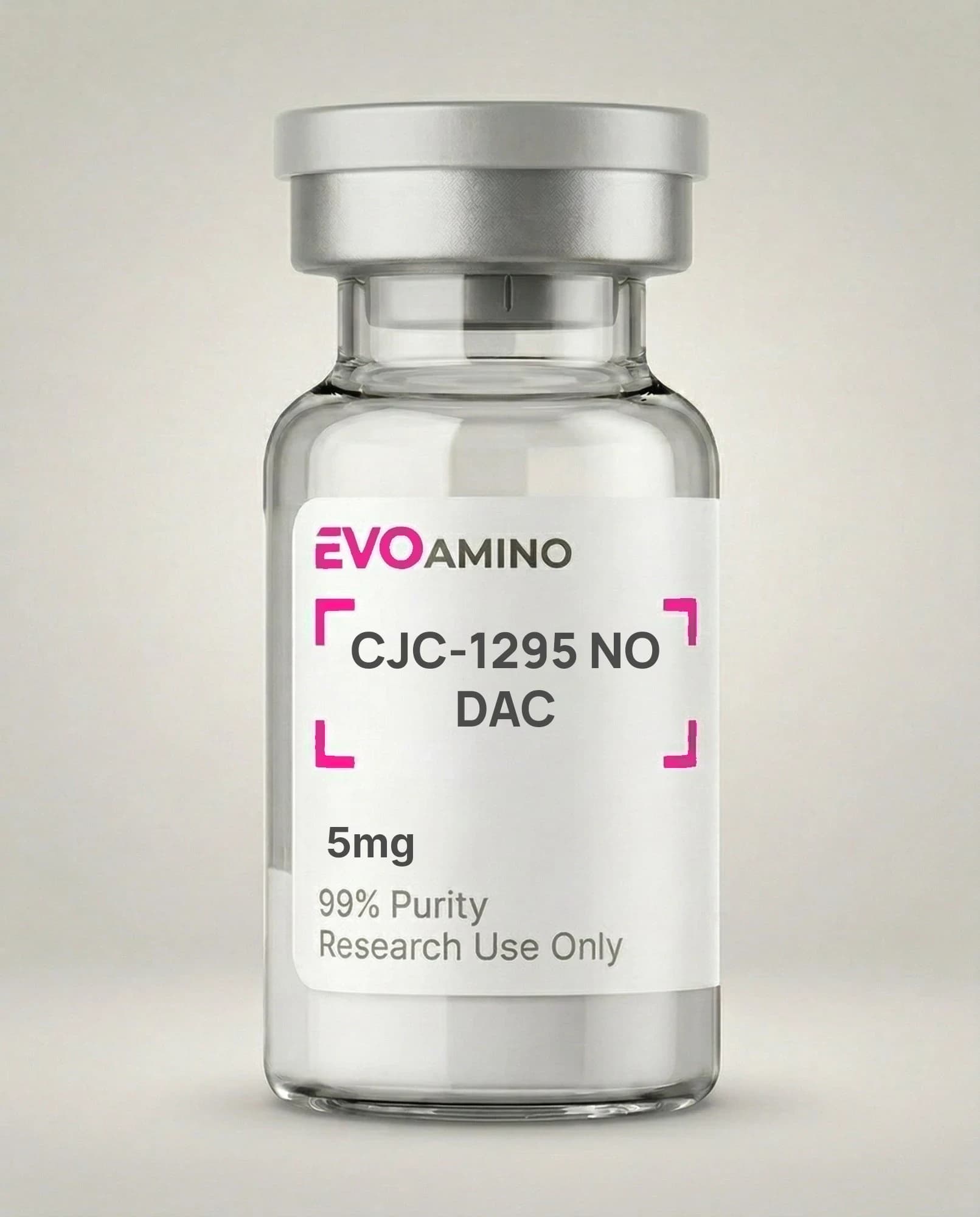
CJC-1295 no DAC, also called Modified GRF (1-29), is the first 29 residues of GHRH with four substitutions (D-alanine at 2, glutamine at 8, alanine at 15, leucine at 27) that protect it from DPP-4 and other proteolytic cleavage while preserving GHRH receptor binding. The "no DAC" designation means it lacks the Drug Affinity Complex, a maleimidopropionic acid linker that in the DAC version binds covalently to serum albumin and extends the half-life from minutes to days. Without the DAC, Mod GRF (1-29) retains the pulsatile release profile of native GHRH, which is why it is the version used in research designed to preserve physiological rhythm. The two are different molecules with different molecular weights and CAS numbers; the Evo Amino catalog carries the no DAC form.
How does tesamorelin differ from CJC-1295 no DAC?
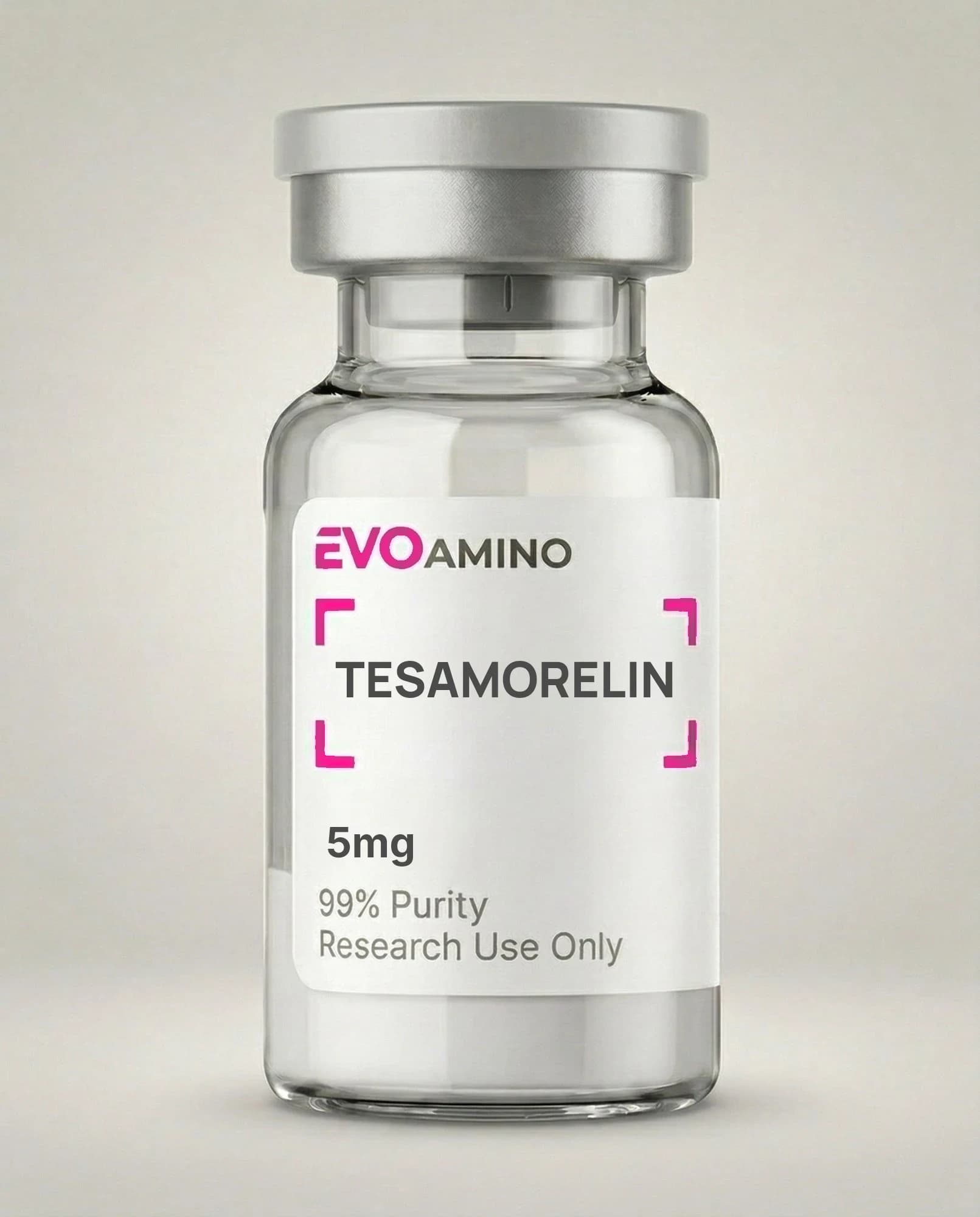
Tesamorelin is the full 44-residue GHRH (1-44) amide sequence with a trans-3-hexenoyl group attached to the N-terminal tyrosine, giving it a molecular weight of 5135.9 g/mol against 3367.9 g/mol for the 29-residue Mod GRF. Both are GHRH receptor agonists. The hexenoyl modification protects the N-terminus from DPP-4 cleavage and extends stability without the covalent albumin binding of the DAC approach. Tesamorelin is also the one compound in this comparison with an approved pharmaceutical form in some jurisdictions, which means a larger body of controlled human pharmacology data exists for it than for either of the other two; that regulatory status applies to the pharmaceutical product, not to research-grade material.
Why are ghrelin mimetics and GHRH analogs studied together?
They are studied together because the two receptor pathways are independent and additive, which allows researchers to isolate each contribution and to test synergy. A typical pituitary cell or perfusion model applies the GHRH analog alone, the ghrelin mimetic alone, and both together, and compares growth hormone output. The pairing of ipamorelin with CJC-1295 no DAC is the most common configuration in the research literature because both are short-acting, so timing can be controlled, and because ipamorelin's selectivity means the combined response is not confounded by cortisol or prolactin changes. Somatostatin tone is the main variable such studies must control, since it modulates both pathways.
What are the analytical considerations for each compound?
The three compounds sit at very different points on the analytical scale. Ipamorelin, at five residues and 712 Da, gives a single dominant peak on reverse-phase HPLC and a simple mass spectrum (predominantly the +1 and +2 ions), and its two D-amino acids mean chiral purity is the relevant concern: an L-epimer at either D position will co-elute or nearly co-elute and can be missed without a chiral or high-resolution method. Mod GRF (1-29) and tesamorelin, at 29 and 44 residues, produce multiply charged mass spectra requiring deconvolution, and their purity figures are more sensitive to deletion sequences and oxidation (tesamorelin contains a methionine at position 27 that oxidizes readily). For all three, a Certificate of Analysis reporting observed versus theoretical mass alongside HPLC purity is the minimum for identity. The co-elution limits article covers why a purity figure alone can hide impurities in longer peptides.
Which compound is appropriate for a given research question?
The receptor question decides it. Research targeting the ghrelin receptor, or requiring a selective growth hormone signal without ACTH or prolactin confounds, uses ipamorelin. Research targeting the GHRH receptor uses Mod GRF (1-29) when short action and pulsatility matter, or tesamorelin when a longer-acting GHRH analog with extensive published pharmacology is needed. Synergy and pathway-interaction studies use one from each class. None of these compounds is interchangeable with another; they are different molecules at different receptors, and a study design that treats them as equivalent has conflated two mechanisms.
All compounds referenced in this article are supplied for research purposes only and are not for human use. Nothing here describes or endorses any use of these materials outside laboratory research. These products are not intended to diagnose, treat, cure, or prevent any disease.
Stay in the loop
New compounds, research updates & exclusive subscriber deals.