
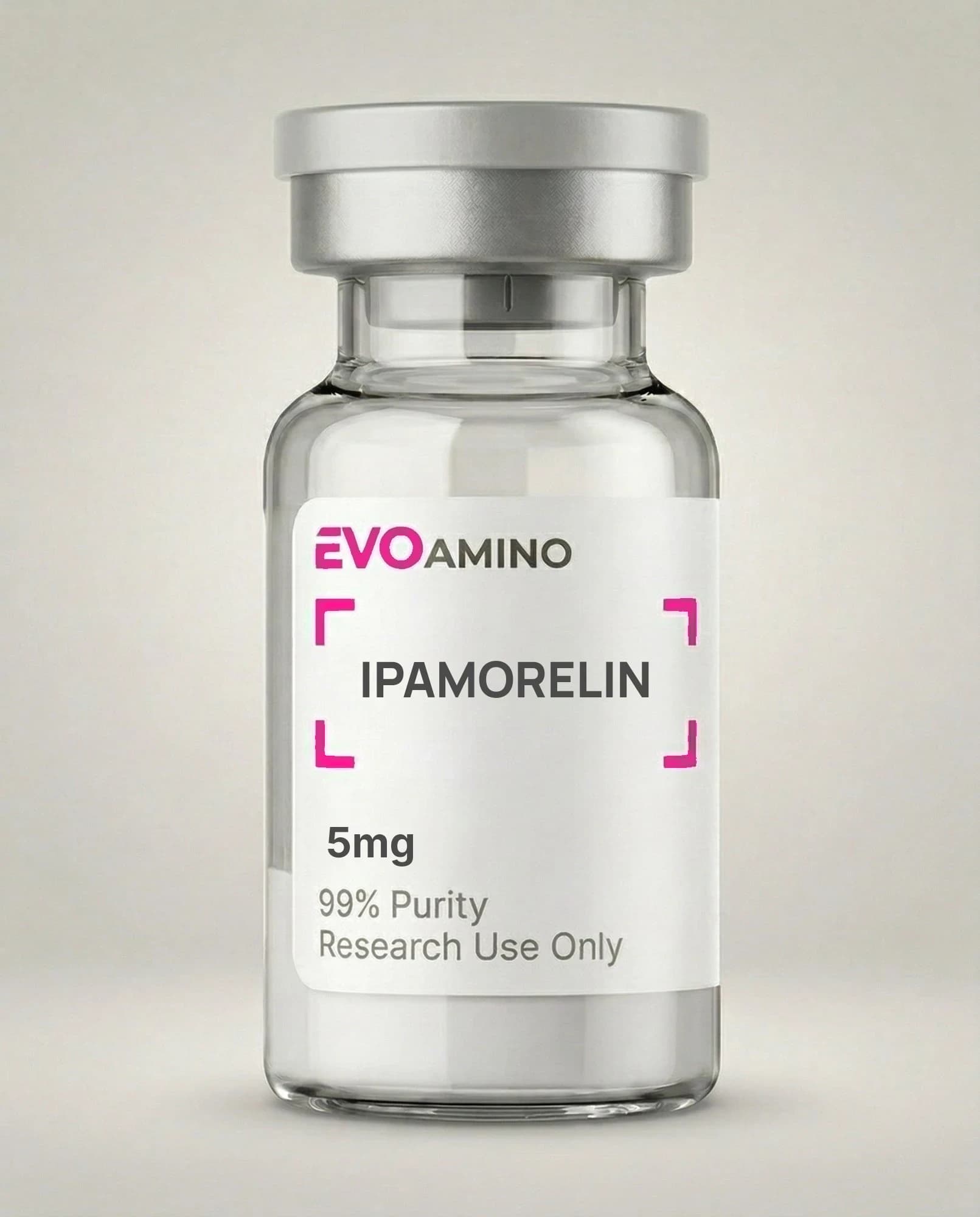
Ipamorelin.
Ipamorelin is a synthetic pentapeptide and selective growth hormone secretagogue. With the molecular formula C₃₈H₄₉N₉O₅ and a molecular weight of 711.9 g/mol (CAS: 170851-70-4), Ipamorelin is derived...
Lab Verified
Clinical Grade
PMID Cited
Mechanism of Action.
Published preclinical research has characterized the following molecular pathways and receptor interactions for Ipamorelin.
GHS-R1a Receptor
Ipamorelin selectively activates the ghrelin receptor (GHS-R1a) on somatotrophs, stimulating growth hormone release without significantly affecting other pituitary hormones.
Intracellular Signaling
Receptor activation triggers phospholipase C-mediated signaling, increasing intracellular calcium and activating protein kinase C.
Clinical Literature
Research review on Ipamorelin molecular characterization.
Preclinical studies have characterized the molecular properties and receptor binding profiles of Ipamorelin in standardized assay systems.
Ipamorelin structure-activity relationship analysis.
Structure-activity relationship studies have examined the functional domains and binding characteristics of Ipamorelin in cell-free and cell-based systems.
Compound Data
| CAS Number | 170851-70-4 |
|---|---|
| Molecular Formula | C38H49N9O5 |
| Molecular Weight | 711.87 g/mol |
| Sequence | Aib-His-D-2-Nal-D-Phe-Lys-NH2 |
| Purity | ≥99% (HPLC verified) |
| Form | Lyophilized powder |
| Storage | −20°C · Lyophilized |
Ipamorelin Questions
What is Ipamorelin?
Ipamorelin is a synthetic pentapeptide (Aib-His-D-2-Nal-D-Phe-Lys-NH2) classed as a growth hormone secretagogue. Evo Amino lists it with molecular formula C38H49N9O5, a molecular weight of 711.9 g/mol, and CAS 170851-70-4. It is supplied lyophilized for in vitro research use only. Not for human use.
Which receptor does Ipamorelin act on in research?
Ipamorelin is an agonist at the ghrelin receptor (GHS-R1a). Published in vitro and preclinical work describes it as selective: it triggers growth hormone release from pituitary cells with little effect on ACTH or cortisol pathways, which separates it from earlier GHRP-family secretagogues such as GHRP-6 and makes it a common selective reference compound.
Why is Ipamorelin called a pentapeptide?
It is built from five residues: alpha-aminoisobutyric acid (Aib), histidine, D-2-naphthylalanine, D-phenylalanine, and lysine, with an amidated C-terminus. The non-natural Aib and D-amino acids make it more resistant to common peptidases in in vitro systems than peptides built only from natural L-amino acids.
What purity level does Evo Amino's Ipamorelin have?
Evo Amino supplies Ipamorelin at ≥99% purity, verified by third-party HPLC and mass spectrometry analysis. Certificates of Analysis are available upon request.
How is Ipamorelin supplied?
Ipamorelin is supplied as a lyophilized powder in sealed research-grade vials, intended for in vitro and laboratory research use only.
RESEARCH USE ONLY: This compound is intended exclusively for in vitro laboratory research. Not for human or veterinary use. Not intended to diagnose, treat, cure, or prevent any disease. Not evaluated by the FDA. Must be 21+ to purchase.
Related Compounds.
 GH Secretagogues
CJC no DAC
$43.00C152H252N44O42 · 3367.9 g/mol
For in vitro research use only. Not for human consumption.
 GH Secretagogues
CJC/IPA
$62.00Blend · Mixed
For in vitro research use only. Not for human consumption.
 GH Secretagogues
FOXO4
$196.00C228H388N86O64 · 5358.06 g/mol
For in vitro research use only. Not for human consumption.
Related Research & Analysis
Ipamorelin vs Other GH Secretagogues: CJC-1295 No DAC and Tesamorelin Research Comparison
Ipamorelin is a 711.9 g/mol pentapeptide ghrelin mimetic acting at GHS-R1a, while CJC-1295 no DAC (3367.9 g/mol) and tesamorelin (5135.9 g/mol) are GHRH-receptor analogs. A structure and receptor-class comparison of the three, with a table, covering selectivity, half-life, why the two classes are studied together, and analytical considerations. For research purposes only.
GH Secretagogue Peptides: Research Specs
Molecular comparison of GHS peptides including CJC-1295, Ipamorelin, Sermorelin, and Tesamorelin. Receptor binding sequences, pharmacokinetic modifications, and published pituitary receptor findings.