* These statements have not been evaluated by the Food and Drug Administration. This product is not intended to diagnose, treat, cure, or prevent any disease. For research purposes only.
What is the best Peptide Sciences alternative for researchers?
When Peptide Sciences ceased operations on March 6, 2026, the research community needed a replacement built on verifiable quality — not just marketing claims. Evo Amino was designed exactly for that standard: a US-based supplier offering 64 research-grade compounds at ≥99% verified purity, with independent third-party Certificates of Analysis, HPLC verification, endotoxin testing, and cold-chain shipping included on every order. No add-ons. No documentation available-on-request. These are the default conditions for every batch that leaves the facility.
The shutdown came without warning. Researchers who had relied on Peptide Sciences for routine procurement — many for years — found their supply chain severed overnight, with no email notification, no order fulfillment timeline, and no guidance on refunds. Independent third-party audits had flagged inconsistencies in purity claims across several popular catalog items in the months prior. The closure sent ripples through academic and independent research programs that depended on consistent, documented compound supply.
What distinguishes Evo Amino in this context is analytical transparency rather than catalog breadth. Rather than attempting to replicate Peptide Sciences' roughly 190-compound catalog, Evo Amino focuses on 64 compounds across five research categories — each independently verified before inventory entry. Every item in the catalog meets a ≥99% purity threshold. Every batch carries a batch-specific Certificate of Analysis that researchers can archive and cite.
For researchers evaluating alternatives in 2026, the central question is not which supplier has the most SKUs. It is which supplier can document exactly what they sell. Evo Amino answers that question with verifiable analytical data on every shipment. The combination of documentation rigor, cold-chain logistics, and quality infrastructure has made it the destination for researchers who need a supplier they can trust with the same confidence — or greater — than they placed in Peptide Sciences.
How does Evo Amino compare to Peptide Sciences?
The table below compares Peptide Sciences (prior to closure) with Evo Amino across the quality and logistics parameters that matter most to researchers evaluating a new supplier.
Feature
Peptide Sciences (Closed)
Evo Amino
Status
Shut down March 2026
Active, shipping daily
Products
~190 compounds
64 research-grade compounds
Purity Standard
Varied (Finnrick exposed failures)
≥99% verified
Third-Party COA
Available on request
Included with every order
HPLC Verification
Yes
Yes — independent third-party
Endotoxin Testing
Not standard
Standard on all compounds
Cold-Chain Shipping
Not standard
Standard on all orders
Mass Spectrometry
Available
Standard verification
Base Location
US
US
Payment Options
Credit card, crypto
PayPal, crypto (10% discount)
The catalog size difference reflects a deliberate quality trade-off. Evo Amino carries 64 compounds rather than 190 because every catalog entry must pass the same verification pipeline — independent testing, HPLC purity, mass spectrometry identity, and endotoxin screening. Expanding catalog scope without maintaining analytical standards would compromise the quality model. Researchers benefit from the certainty that every listed compound has been independently tested to the same threshold, without exceptions or tiered quality levels by product category.
Cold-chain logistics represent another structural divergence. Peptide Sciences offered temperature-controlled packaging on select items as an option. Evo Amino includes cold-chain packaging on every order regardless of compound or order size. Peptide stability during transit is not a premium concern reserved for specific compounds — it is a universal quality parameter. Removing the decision point eliminates a variable that could compromise experimental outcomes.
Documentation defaults also differed materially. Peptide Sciences required researchers to actively request Certificates of Analysis. Evo Amino ships batch-specific COAs automatically with every order. This difference matters operationally: quality documentation becomes the default rather than an afterthought, simplifying compliance for institutional researchers who need auditable procurement records.
What products does Evo Amino carry?
Evo Amino's catalog spans five research categories, each containing compounds selected based on established research interest and citation frequency in published literature. All compounds are available for research purposes only.
GH Secretagogues (11 compounds): Ipamorelin, CJC-1295 NO DAC, Sermorelin Acetate, Tesamorelin, IGF-1LR3, and more. This category covers growth hormone secretagogue research compounds widely referenced in endocrine and metabolic studies.
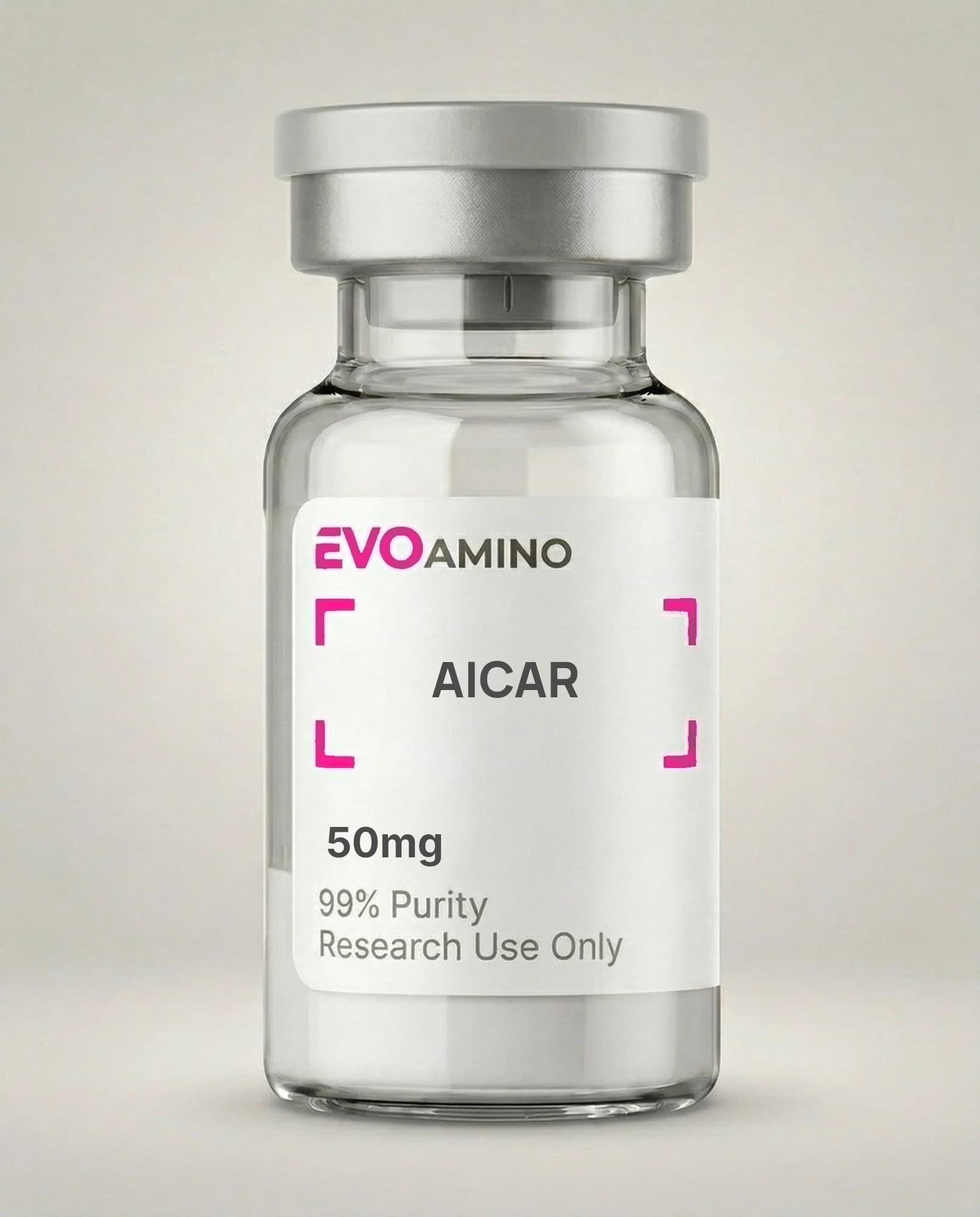
Metabolic (17 compounds): GLP-1, GLP-2, GLP-3, Cagrilintide, Mazdutide, AICAR, SLU-PP-332, and more. The metabolic category includes incretin analogs and metabolic pathway modulators that represent some of the most actively studied compound classes in current research.
Healing (15 compounds): BPC-157, TB500, GHK-CU, KPV, Thymosin Alpha-1, Follistatin, and more. These compounds are the subject of ongoing research into tissue repair mechanisms, immune modulation, and cellular signaling pathways.
Cognitive (5 compounds): Semax, Selank, DSIP, Pinealon, Cerebrolysin. The cognitive category focuses on neuropeptides and related compounds studied in the context of neurotrophic factors, neuroprotection, and cognitive function research.
Longevity (11 compounds): Epitalon, NAD+, MOTS-c, SS-31, FOXO4, Glutathione, and more. Longevity compounds include mitochondrial-targeted peptides, telomerase-related compounds, and cellular defense molecules studied in aging and senescence research.
Each category is curated rather than exhaustive. Evo Amino adds new compounds based on demonstrated research demand and the ability to source them at the ≥99% purity threshold required for catalog inclusion.
What Peptide Sciences products are available at Evo Amino?
Researchers who previously ordered from Peptide Sciences will find direct equivalents for many of the most commonly ordered catalog items. The table below maps popular Peptide Sciences products to their Evo Amino equivalents with current pricing.
Note that quantities differ between suppliers in several cases. Evo Amino prices reflect the listed size for each compound — researchers should compare on a per-milligram basis where quantities differ. All Evo Amino products include third-party COA and cold-chain shipping at the listed price with no additional fees.
Crypto payments receive an automatic 10% discount at checkout, making the effective per-milligram cost even lower on every catalog item.
Evo Amino's pricing structure bundles in costs that were conditional or absent with Peptide Sciences: third-party COA documentation and cold-chain shipping are included as standard rather than premium add-ons. Researchers who previously paid extra for temperature-controlled shipping will find those costs absorbed into the base price. The total procurement cost through Evo Amino is often lower than a surface-level price comparison suggests.
Why did quality matter in the Peptide Sciences shutdown?
The closure of Peptide Sciences occurred against a backdrop of documented third-party quality failures. In late 2025 and early 2026, Finnrick Analytics published a series of independent analytical reports that identified serious purity and identity failures across multiple major suppliers, including Peptide Sciences. These were not isolated batch anomalies — they were systemic findings.
Finnrick's analysis of Retatrutide returned a failing E rating across 37 independent samples, indicating that quality failures were distributed across the batch production system rather than isolated to a single lot. CJC-1295 testing produced an average score of 4.3 out of 10 across sampled suppliers. Counterfeit detection flags appeared on certain compound categories in late 2025, suggesting that some products sold under recognized compound names did not match their labeled molecular identity.
These findings demonstrate why independent third-party verification is not a quality bonus — it is the only mechanism by which researchers can distinguish genuine ≥99% purity from unverified marketing claims. When a supplier conducts only internal testing and self-reports results, the absence of an independent check means quality failures can persist at scale before anyone outside the company detects them.
Evo Amino's analytical model was engineered to close this gap. Every batch undergoes independent third-party testing before inventory entry. HPLC confirms purity percentage. Mass spectrometry confirms molecular identity. Endotoxin testing screens for contamination. The resulting Certificate of Analysis ships with every order — batch-specific, not a recycled generic document. This is not a quality marketing narrative. It is a structural feature of the supply chain that makes the kind of systemic failures documented by Finnrick materially harder to sustain undetected.
The post-Peptide Sciences research market is recalibrating around this principle: catalog breadth and brand recognition are not proxies for compound quality. Researchers are increasingly directing procurement toward suppliers who can document what they sell rather than those who simply claim it.
How do I order from Evo Amino?
The full catalog is available at evoamino.com/compounds, organized by research category with compound specifications and available sizes. All products ship with a batch-specific Certificate of Analysis and cold-chain packaging included in the listed price — no additional fees apply.
Evo Amino accepts PayPal and cryptocurrency. Crypto payments receive an automatic 10% discount at checkout. All orders ship from the United States. A research acknowledgment is required at checkout — Evo Amino enforces a 21+ age gate and requires purchasers to confirm research-only use. This applies to every order without exception.
For researchers transitioning from Peptide Sciences, the onboarding process is minimal: browse the catalog, select compounds, and create an account. New account setup takes under a minute and provides access to order history, tracking, and COA documentation for all past orders.
Researchers managing ongoing programs benefit from Evo Amino's reorder infrastructure: previous orders are accessible, COA documentation for all historical batches is retrievable, and recurring compound lists can be rebuilt quickly. For labs that maintained standing orders with Peptide Sciences and need to re-establish supply continuity, this ordering history system reduces administrative friction when re-establishing procurement workflows. Questions about bulk pricing or institutional purchasing can be directed to the team via the website contact form, with typical response times within one business day.
For research use only. Not for human consumption. All compounds sold by Evo Amino are intended exclusively as laboratory research materials. Evo Amino makes no claims regarding the therapeutic, diagnostic, or medicinal use of any product. Purchasers must confirm they are 21 years of age or older and that all materials will be used in accordance with applicable research regulations.
Stay in the loop
New compounds, research updates & exclusive subscriber deals.